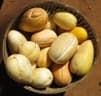
Cucumis melo momordica
Cucumis melo momordica
Safety & Hazards
The sprouting seed produces a toxic substance in its embryo[1].
Cultivation Details
Snap melons are cultivated from the warm temperate zone through to the tropics, where they can be grown at elevations up to 1,000 metres. They grow best in areas where annual daytime temperatures are within the range 18 - 30°c, but can tolerate 9 - 35°c[2]. They are killed by frost[3]. They prefer a mean annual rainfall in the range 1,000 - 1,300mm, but tolerate 900 - 2,500mm[2]. They grow best in areas without too much rainfall or too high a humidity, since these conditions reduce fertilization and lead to diseases of the leaves[3]. Requires a rich, well-drained moisture retentive soil and a warm, very sunny position[4]. Prefers a pH in the range 6 - 7.5, tolerating 5 - 8.7[2]. It takes 3 - 4 months to produce a crop from seed[3]. Individual plants are usually allowed to bear about four melons, and a crop of melons should yield about 5 - 30 tonnes/ha, with an average about 11 - 13 tonnes/ha[2]. This form is also of value in breeding programmes for pest and disease resistance.
Propagation
Seed - sow early to mid spring in a greenhouse in a rich soil. Germination should take place within 2 weeks. Sow 2 or 3 seeds per pot and thin out to the best plant. Grow them on fast and plant out after the last expected frosts, giving them cloche or frame protection for at least their first few weeks if you are trying them outdoors. Cite as: Temperate Plants Database, Ken Fern. temperate.theferns.info. 2026-02-21. <temperate.theferns.info/plant/Cucumis+melo+momordica>
Pollinators
Insects
References
- [1]A Colour Atlas of Poisonous Plants. — Frohne. D. and Pfänder. J. · Wolfe · 1984 · ISBN 0723408394 ↩︎Brilliant. Goes into technical details but in a very readable way. The best work on the subject that I've come across so far.
- [2]Ecocrop — http://ecocrop.fao.org/ecocrop/srv/en/home ↩︎Basic information on a wide range of useful plants, plus details of environmental needs where available.
- [3]Vegetables in the Tropics — Tindall. H. D. · MacMillan, Oxford. · 1983 · ISBN 0-333-24268-8 ↩︎An excellent, in-depth look at the main vegetable crops that can be grown in the Tropics, plus many less well-known plants.
- [4]The New RHS Dictionary of Gardening. 1992. — Huxley. A. · MacMillan Press · 1992 · ISBN 0-333-47494-5 ↩︎Excellent and very comprehensive, though it contains a number of silly mistakes. Readable yet also very detailed.
- [5]Cornucopia - A Source Book of Edible Plants. — Facciola. S. · Kampong Publications · 1990 · ISBN 0-9628087-0-9 ↩︎Excellent. Contains a very wide range of conventional and unconventional food plants (including tropical) and where they can be obtained (mainly N. American nurseries but also research institutes and a lot of other nurseries from around the world.
- [6]Plants for Man. — Schery. R. W. ↩︎Fairly readable but not very comprehensive. Deals with plants from around the world.
- [7]Gourds. — Organ. J. · Faber · 1963 · ISBN - ↩︎Deals with squashes and their relatives. Interesting and readable, it gives cultivation techniques and some details of plant uses.
- [8]Tanaka's Cyclopedia of Edible Plants of the World. — Tanaka. T. & Nakao S. · Keigaku Publishing; Tokyo · 1976 · ISBN - ↩︎The most comprehensive list of edible plants I've come across. Only the briefest entry for each species, though, and some of the entries are more than a little dubious. Not for the casual reader.
- [9]Medicinal Plants of China — Duke. J. A. and Ayensu. E. S. · Reference Publications, Inc. · 1985 · ISBN 0-917256-20-4 ↩︎Details of over 1,200 medicinal plants of China and brief details of their uses. Often includes an analysis, or at least a list of constituents. Heavy going if you are not into the subject.
- [10]A - Z of Companion Planting. — Allardice.P. · Cassell Publishers Ltd. · 1993 · ISBN 0-304-34324-2 ↩︎A well produced and very readable book.
- [11]Encyclopaedia of Medicinal Plants. — Chiej. R. · MacDonald · 1984 · ISBN 0-356-10541-5 ↩︎Covers plants growing in Europe. Also gives other interesting information on the plants. Good photographs.
- [PFAF]Plants for a Future — pfaf.org ↩︎