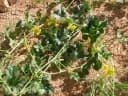
Cucumis africanus
Cucumis africanus
Safety & Hazards
The fruits, especially the bitter forms, contain considerable amounts of cucurbitacin A, B and D and traces of cucurbitacin G and H. Cucurbitacins, which are known from many Cucurbitaceae and various other plant species, have been shown to exhibit cytotoxicity (including antitumor activity), anti-inflammatory and analgesic activities[1].
Cultivation Details
A plant of drier areas in the tropics - in S. Africa it grows in areas where the mean annual rainfall is within the range 100 - 800mm[2]. Succeeds in full sun and also grows well in partial shade in very sunny areas[2]. Leaves are larger and less hairy when the plant is given some shade[2]. There are three basic forms of this species:- Plants with non-bitter, large and oblong fruits are found growing wild in Angola, Namibia and South Africa[1]. A form with smaller, ellipsoid fruits is also - these fruits are bitter, possibly poisonous and unsuitable for consumption[1]. A third type, intermediate in taste and shape between the first two, seems to exist as well[1].
Propagation
Seed - Cite as: Tropical Plants Database, Ken Fern. tropical.theferns.info. 2026-02-20. <tropical.theferns.info/viewtropical.php?id=Cucumis+africanus>
Pollinators
Bees, Insects
References
- [1]Protabase - Plant Resources of Tropical Africa. — http://www.prota.org ↩︎An excellent on-line database with detailed information on over 3,200 species of useful plants of Africa.
- [2]PlantZAfrica.com — http://www.plantzafrica.com ↩︎An excellent site giving detailed descriptions and uses of many S. African plants.
- [3]Flora Zambesiaca — http://apps.kew.org/efloras/fz/intro.html ↩︎An excellent online flora of plants from the Zambezi River basin. It lists a number of the plant uses as well as the habitats and botanical descriptions of the plants.
- [4]Cornucopia II — Facciola. S. · Kampong Publications, California. · 1998 · ISBN 0-9628087-2-5 ↩︎The second edition of an excellent guide to the edible uses of plants, though it does not give any details of cultivation etc.
- [5]Gemsbok Bean and Kalahari Truffle — Leffers A. · Gamsberg MacMillan; Namibia. · 2003 · ISBN 99916-0-491-X ↩︎Details of the traditional uses of over 200 species of plants in northeastern Namibia. Written for the non-expert, there is usually at least one photograph with each plant entry.