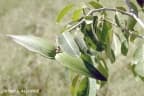
Cryptostegia madagascariensis
Cryptostegia madagascariensis
Cultivation Details
Cryptostegia madagascariensis is natve to northwestern Madagascar and can flourish in areas where the mean annual rainfall can range from 400 - 2,400mm[1]. It is also able to extend its range into drier areas with 400mm or less of annual rainfall. Plants cannot tolerate frost[1] The plant is tolerant of a wide variety of soil types[1]. Tolerant of saline soils[1]. Cryptostegia madagascariensis is a fast-growing invasive woody vine. Originally native to north-western Madagascar, 0t has become widely distributed in India, Kenya, Brazil, Hawaii, Australia and the West Indies. Plants can begin to reproduce after about 200 days and they can produce large amount of seeds which are rapidly dispersed by wind, floodwaters, or stuck to the fur of animals. Seeds can remain viable up to one year and studies have reported germination rates ranging from 90 to 95%. The plant has the ability to quickly spread along water courses, coastal forests, pastures, forest edges, and disturbed areas. It can form dense impenetrable thickets by climbing up trees and covering them, and may also displace and out-compete native vegetation[1]. A long-lived species, living for several decades[1].
Propagation
Seed - germination requires high humidity and temperatures around 30°c. Viability is more than 90% in fresh seeds, but viability only lasts for a year or less at room temperature[1]. Cite as: Tropical Plants Database, Ken Fern. tropical.theferns.info. 2026-02-20. <tropical.theferns.info/viewtropical.php?id=Cryptostegia+madagascariensis>
Pollinators
Bees, Insects
References
- [1]Invasive Species Compendium — http://www.cabi.org ↩︎An immense resource - in depth information on over 900 species of invasive plants (it also has information on animals, fungi etc).
- [2]Annals of the Missouri Botanical Garden Vol. 62 — Missouri Botanical Garden · 1975 ↩︎An excellent botanical publication, available for download from the Internet. This volume contains the Asclepiadaceae section of the Flora of Panama.
- [3]Dictionary of Economic Plants. — Uphof. J. C. Th. · Weinheim · 1959 · ISBN - ↩︎An excellent and very comprehensive guide but it only gives very short descriptions of the uses without any details of how to utilize the plants. Not for the casual reader.
- [4]Rubber. Its Sources, Cultivation and Preparation. — Brown H. · John Murray; London. · 1914 · http://www.biodiversitylibrary.org/ ↩︎Written in the days before synthetic rubbers and the loss of interest in finding new rubber sources. A good amount of information on latex-producing plants. It can be downloaded from the Internet.
- [5]Useful Fiber Plants of the World — Dodge C.R. · USDA; Washington. · 1897 · http://www.biodiversitylibrary.org/ ↩︎A rather dated, but very comprehensive catalogue of fibre plants from around the world. The book can be downloaded from the Internet.