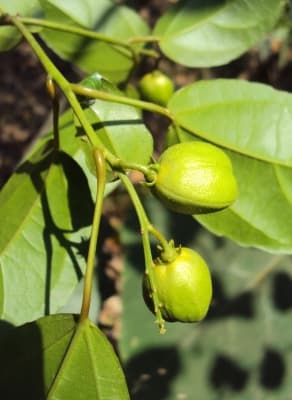
Croton tiglium
Croton tiglium
Safety & Hazards
All parts of the plant are poisonous[1]. The seeds are known to be very poisonous, and are used as fish poison or for criminal purposes - four seeds can be a lethal dose for a human adult[1]. The toxic principles are crotonol, an extremely vesicant resin; and crotin, a delayed-action poison which causes blood-clotting. Symptoms of croton oil poisoning are firstly pain at the back of the throat, then in the anus. A dose of bismuth is an immediate antidote[2]. Croton oil, obtained from the seed, is heavily irritating; contact with the skin causes inflammation and oedema[3]. Croton tiglium poisoning is traditionally treated with a decoction of Coptis teeta and string beans[4]. Several esters of the diterpene phorbol have been isolated from croton resin. Some of these have shown antileukaemic activity but in general, however, these phorbol esters as found in Croton tiglium and many other Croton species are extremely irritant and also tumour promotors. Their presence in Croton tiglium and Croton flavens means their consumption is sometimes held responsible for certain forms of nasopharyngeal cancer as they are able to activate Epstein-Barr viruses[5, 3].
Cultivation Details
A plant of the lowland tropics and subtropics, it tolerates an annual rainfall of 600 - 1,200 mm and an annual temperature in the range 21 - 27.5°c[1]. Succeeds in soils with a pH ranging from 4.5 - 7.5[1]. Succeeds in very poor soils[2]. Plants start flowering after about 18 months, Seed yield in the third year may be 200 - 750 kg seed/ha[1]. By the sixth year plants have reached full bearing and yields are 750 - 1,000, occasionally to 2,000 kg/ha[1]. The seed oil of Croton tiglium is commonly used in laboratories throughout the world for its vesicant properties. The phorbol esters isolated from the oil also have interesting tumour-promoting or tumour-inhibiting properties, and although much research has been done, more is needed to elucidate their future potential. As the other parts of the plant are poisonous as well, it might be worthwhile investigating their chemistry and pharmacology. A large number of pharmaceutical applications of Croton tiglium are being patented in China. The extensive ongoing research may lead to new developments elsewhere too[1].
Propagation
Seed - Cuttings Cite as: Tropical Plants Database, Ken Fern. tropical.theferns.info. 2026-02-20. <tropical.theferns.info/viewtropical.php?id=Croton+tiglium>
Pollinators
Insects
References
- [1]Protabase - Plant Resources of Tropical Africa. — http://www.prota.org ↩︎An excellent on-line database with detailed information on over 3,200 species of useful plants of Africa.
- [2]The Useful Plants of West Tropical Africa. — Burkil. H. M. · Royal Botanic Gardens; Kew. · 1985 - 2004 ↩︎Brief descriptions and details of the uses of over 4,000 plants. A superb, if terse, resource, it is also available electronically on the Web - see http://www.aluka.org/
- [3]Vegetable Fats and Oils — Krist S. (Translated by Barbara Bauer) · Springer Nature; Switzerland · 2020 · https://doi.org/10.1007/978-3-030-30314-3 · ISBN 978-3-030-30314-3 ↩︎
- [4]Medicinal Plants in Vietnam — Nguyen Van Dan & Doan Thi Nhu · World Health Organisation · 1989 · ISBN 92 9061 101 4 ↩︎An excellent book, giving information on over 200 plants, their medicinal compounds and applications.
- [5]Plant Resources of Southeast Asia — http://proseanet.org/ ↩︎Lots of information on the uses of the plants of SE Asia.
- [6]IUCN Red List of Threatened Species — http://www.iucnredlist.org/ ↩︎A list of plants under threat and facing possible extinction, usually with brief details of the threats and information on habitat.
- [7]Flora of China — Missouri Botanical Garden Press; St. Louis. · 1994 · http://flora.huh.harvard.edu/china/ ↩︎An excellent, comprehensive resource in 25 volumes. In addition to the botanical information the flora also gives basic information on habitat and some uses. An on-line version is also available.
- [8]Enciclopedia de las Plantas Útiles del Ecuador — de la Torre, L., Navarrete H., P. Muriel M., Macía M.J. & Ba · Herbario QCA de la Escuela de Ciencias Biológicas de la Pontific · 2008 · ISBN 978-9978-77-135-8 ↩︎