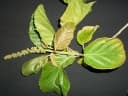
Cultivation Details
HabitSemi-deciduous Tree
Growth—
A plant of the subtropics to the tropics, where it can be found at elevations up to 1,700 metres. Especially when young, the plant is susceptible to damage by frost[3]. Succeeds in full sun and in moderate to deep shade[1]. Requires a position sheltered from cold winds[3]. A fast-growing tree, able to increase in height by 150cm per year[2, 3].
Propagation
Seed - sow in a semi-shady position in a nursery seedbed. It germinates in 2 - 3 weeks[1]. Pot up the seedlings when they have two true leaves[1]. Cite as: Tropical Plants Database, Ken Fern. tropical.theferns.info. 2026-02-20. <tropical.theferns.info/viewtropical.php?id=Croton+sylvaticus>
Pollinators
Bees
References
- [1]Protabase - Plant Resources of Tropical Africa. — http://www.prota.org ↩︎An excellent on-line database with detailed information on over 3,200 species of useful plants of Africa.
- [2]PlantZAfrica.com — http://www.plantzafrica.com ↩︎An excellent site giving detailed descriptions and uses of many S. African plants.
- [3]World Agroforesty Centre — http://www.worldagroforestry.org/ ↩︎An excellent online database of a huge range of trees giving very good information on each plant - its uses, ecology, identity, propagation, pests etc.
- [4]The Useful Plants of West Tropical Africa. — Burkil. H. M. · Royal Botanic Gardens; Kew. · 1985 - 2004 ↩︎Brief descriptions and details of the uses of over 4,000 plants. A superb, if terse, resource, it is also available electronically on the Web - see http://www.aluka.org/
- [5]IUCN Red List of Threatened Species — http://www.iucnredlist.org/ ↩︎A list of plants under threat and facing possible extinction, usually with brief details of the threats and information on habitat.