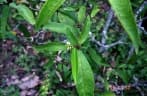
Croton stellatopilosus
Croton stellatopilosus
Safety & Hazards
None known
Cultivation Details
Most Croton species are relatively indifferent to their habitat and can grow on a wide range of soils in both disturbed and undisturbed vegetation[1]. A fast-growing species, seedlings can reach a height of 2 - 4 metres within 3 - 4 years[1]. Croton stellatopilosus can be successfully propagated by shoot tip culture technique for rapid multiplication of superior plant material with higher plaunotol content[1]. The plant can be successfully grafted onto the roots of Croton persimilis in order to obtain protection from root rot. No root rot was observed in the grafted plants during the year after grafting. In addition, grafting promoted the vegetative growth of Croton stellatopilosus and did not affect the plaunotol content of leaves[1]. For commercial production, the plants are cut back to about 2 metres above ground; stems with few branches are thinned and branches with only a few buds cut back. During the growing season only the top part of branches with many leaves are lightly cut back. Heavy pruning is avoided to secure an increase in leaf yield and plaunotol content in the leaves of the next harvest. Following this system leaves can be harvested three times a year; at the early stage of vegetative growth, then again around 8 weeks and 20 weeks after the first harvest[1] In plantations of less than 2 years old, the use of Calopogonium mucunoides Desv. as a cover crop has been found to be effective methods of weed control[1] Through appropriate pruning the dry-weight yield of 7-year-old plants can be increased from 341g to 905g leaves and from 3.3g to 6.2g plaunotol, respectively. Plaunotol content is highest in young leaves. The annual production of a 1,200 ha plantation in Thailand was estimated at 1,700 tonnes of dried leaves[1].
Propagation
Seed - Scions can be successfully side-grafted onto rootstocks of Croton persimilis, a species not susceptible to root rot under comparable conditions[1]. Cite as: Tropical Plants Database, Ken Fern. tropical.theferns.info. 2026-02-20. <tropical.theferns.info/viewtropical.php?id=Croton+stellatopilosus>
Pollinators
Data unavailable
References
- [1]Plant Resources of Southeast Asia — http://proseanet.org/ ↩︎Lots of information on the uses of the plants of SE Asia.
- [2]Flora of Thailand - Euphorbiaceae — van Welzen P.C. · http://www.nationaalherbarium.nl/thaieuph/ ↩︎An excellent site with masses of information about the species of Euphorbia found in Thailand.
- [3]Anti-inflammatory activity of diterpenes from Croton stellatopilosus on LPS-induced RAW264.7 cells — Premprasert C. et al · 2013 · http://10.1007/s11418-012-0668-5 · ISBN 1340-3443 ↩︎