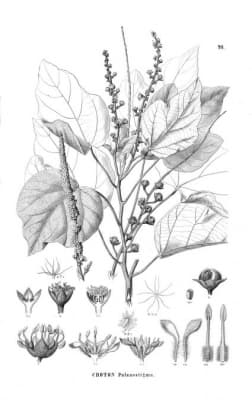
Euphorbiaceae FAMILY
Croton palanostigma
Croton palanostigma
Edibility
0/5
Medicinal
4/5
Safety & Hazards
None known
Cultivation Details
HabitTree
Growth—
Most Croton species are relatively indifferent to their habitat and can grow on a wide range of soils in both disturbed and undisturbed vegetation[1]. This species is one of several that supply a red resin from their stem. This resin, often known as 'Dragon's Blood' is often used as an external application to treat a range of skin problems and injuries[2]. Dragon's Blood can be obtained from several species in this genus, as well as from three other distinct genera - Dracaena species, Daemonorops species and Pterocarpus species[2]
Propagation
Seed - Cite as: Tropical Plants Database, Ken Fern. tropical.theferns.info. 2026-02-20. <tropical.theferns.info/viewtropical.php?id=Croton+palanostigma>
Pollinators
Data unavailable
References
- [1]Plant Resources of Southeast Asia — http://proseanet.org/ ↩︎Lots of information on the uses of the plants of SE Asia.
- [2]A Systematic Review of the Botanical, Phytochemical and Pharmacological Profile of Dracaena cochinchinensis, a Plant — Jia-Yi Fan et al · 2014 · http://10.3390/molecules190710650 · ISBN 1420-3049 ↩︎
- [3]Raintree Nutrition - Tropical Plant Database — http://www.rain-tree.com/plants.htm ↩︎Detailed information on the medicinal uses of more than two hundred rainforest plants, mainly from S. America, with basic descriptions of the plants, their other uses etc.
- [4]Woods of Northeastern Peru — Williams L. · Field Museum Press; Chicago. · 1936 · http://www.biodiversitylibrary.org/ ↩︎Gives information on the properties of the wood of well over 1,000 species of woody plants from northeastern Peru. Can be downloaded from the Internet.
- [5]As espécies de Croton L. sect. Cyclostigma Griseb. e Croton L. sect. Luntia (Raf.) G. L. Webster subsect. Matourense — Guimarães L.A.C. & Secco R.de S. · 2010 ↩︎
- [6]Estudio fitoquímico de la corteza de Croton gossypiifolius colectada en Venezuela — Suárez A.I. et al · 2013 ↩︎