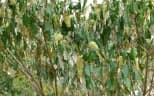
Cultivation Details
Croton megalocarpus is a plant of the tropics, where it can be found at elevations from 700 - 2,400 metres. It is most commonly found in regions with a mean annual rainfall of 900 - 1,900 mm, with a dry season of 3 - 4 months and a mean annual temperature of 11 - 26°c[1]. Prefers light, deep and well-drained soils[1, 2]. Most Croton species are relatively indifferent to their habitat and can grow on a wide range of soils in both disturbed and undisturbed vegetation[3]. Established plants are drought tolerant[1]. Being a natural pioneer of large forest gaps and forest margins, regeneration of this species is often prolific in the wild. It has been reported to become invasive under favourable climatic conditions[1]. A fast-growing tree in favourable conditions[1, 2]. In Kenya seedlings reached a height of 1.7 metres in one year; in Rwanda they were 3 metres tall in 2 years and 11.5 metres in 5 years; whilst in Burundi planted trees were only an average of 3.6 metres tall 7 years after planting, and 15 metres tall with a bole diameter of 24cm after 32 years[1]. Trees may already start flowering when they are 4 years old. The flowers are short-lived and pollinated by insects such as bees. Fruits take about 5 months to ripen after flowering[1]. The tree can be managed by lopping, pollarding and coppicing[1, 2]. When planted in hedges, plants should be pruned for the first time after 2 years[1]. Preliminary observations indicate that a yield of 25 - 30 kilos of seed per tree per year is realistic[1]. At the end of their productive life in bio-fuel plantations, approximately 50 years after planting, trees can be felled for their timber[1].
Propagation
Seed - does not require pre-treatment, but is best sown as soon as it is ripe. The seed is generally sown directly where the tree is to grow, though it is also sometimes sown in a shaded position into individual pots and then planted out later. For fresh seed, a germination rate of around 95% can be expected, with the seeds sprouting within 45 days[1, 2]. Because of its high oil content, the seed has a relatively short viability of around 9 months[2]. Seed stored in plastic containers for up to 1 year at 3°c had a germination rate of 80%[1]. Cite as: Tropical Plants Database, Ken Fern. tropical.theferns.info. 2026-02-20. <tropical.theferns.info/viewtropical.php?id=Croton+megalocarpus>
Pollinators
Data unavailable
References
- [1]Protabase - Plant Resources of Tropical Africa. — http://www.prota.org ↩︎An excellent on-line database with detailed information on over 3,200 species of useful plants of Africa.
- [2]Indigenous multipurpose trees of Tanzania. — Hines. D.A. & Eckman. K. · 1993 · ISBN 0-9697075-0-9 ↩︎A simple handbook with information on over 50 species of trees found in Tanzania giving details of environmental requirements, cultivation needs, uses etc. It can be downloaded from the Internet.
- [3]Plant Resources of Southeast Asia — http://proseanet.org/ ↩︎Lots of information on the uses of the plants of SE Asia.
- [4]CosIng — http://ec.europa.eu/growth/tools-databases/cosing/ ↩︎CosIng is the European Commission database for information on cosmetic substances and ingredients.
- [5]Tropical Timbers of the World. Ag. Handbook No. 607. — Chudnoff. Martin. · USDA Forest Service. Wisconsin. · 1984 ↩︎Terse details on the properties of the wood of almost 400 species of trees from the Tropics.
- [6]World Agroforesty Centre — http://www.worldagroforestry.org/ ↩︎An excellent online database of a huge range of trees giving very good information on each plant - its uses, ecology, identity, propagation, pests etc.