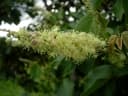
Croton macrostachyus
Croton macrostachyus
Cultivation Details
Plants can be grown in the tropics and subtropics at elevations from 200 - 2,000 metres[1]. They grow best in areas where the mean annual rainfall is within the range 150 - 1,200mm[2]. Succeeds in full sun as well as in moderate shade[2]. Established plants are drought tolerant[2]. Trees are fairly fast growing on good sites, with annual height increases of up to 150cm, but they grow slowly on drier sites[2, 1]. The tree has a long taproot and numerous side-roots, which makes it adapted to dry climates[2]. The tree responds well to lopping, pollarding and coppicing[1]. A dioecious species, with occasional monoecious specimens[1]. Generally, both male and female forms need to be grown if seed is required.
Propagation
Seed - pre-sowing treatment is not necessary. Direct sowing is the preferred method. Under ideal conditions, seeds germinate within 30 - 60 days, with an expected germination rate of healthy, mature seedlots being about 40-70%[2, 1]. The fruits are sun dried to release seeds and can be stored for some months if kept cool, dry and free from insects. Seeds can be stored for at least 2 years when dried to below 8% mc and stored cool (20 deg. C or less)[1]. Cite as: Tropical Plants Database, Ken Fern. tropical.theferns.info. 2026-02-20. <tropical.theferns.info/viewtropical.php?id=Croton+macrostachyus>
Pollinators
Bees
References
- [1]World Agroforesty Centre — http://www.worldagroforestry.org/ ↩︎An excellent online database of a huge range of trees giving very good information on each plant - its uses, ecology, identity, propagation, pests etc.
- [2]Protabase - Plant Resources of Tropical Africa. — http://www.prota.org ↩︎An excellent on-line database with detailed information on over 3,200 species of useful plants of Africa.
- [3]IUCN Red List of Threatened Species — http://www.iucnredlist.org/ ↩︎A list of plants under threat and facing possible extinction, usually with brief details of the threats and information on habitat.
- [4]Flora Zambesiaca — http://apps.kew.org/efloras/fz/intro.html ↩︎An excellent online flora of plants from the Zambezi River basin. It lists a number of the plant uses as well as the habitats and botanical descriptions of the plants.
- [5]The Useful Plants of West Tropical Africa. — Burkil. H. M. · Royal Botanic Gardens; Kew. · 1985 - 2004 ↩︎Brief descriptions and details of the uses of over 4,000 plants. A superb, if terse, resource, it is also available electronically on the Web - see http://www.aluka.org/
- [6]Dictionary of Economic Plants. — Uphof. J. C. Th. · Weinheim · 1959 · ISBN - ↩︎An excellent and very comprehensive guide but it only gives very short descriptions of the uses without any details of how to utilize the plants. Not for the casual reader.
- [7]Useful Trees and Shrubs in Eritrea — Bein. E.; Habte. B.; Jaber. A.; Birnie. A. & Tengnas. B. · Regional Soil Conservation Unit: Nairobi · 1996 · ISBN 9966-896-24-4 ↩︎A very well written and concise guide to almost 200 species. It gives a brief description of each plant together with its habitat, uses, propagation and cultivation. Line drawings of each plant are also included It can be downloaded from the internet