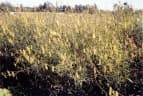
Crotalaria ochroleuca
Crotalaria ochroleuca
Safety & Hazards
The seeds contain slow-acting pyrrolizidine alkaloids that may cause damage to lungs and liver[1]. Pyrrolizidine alkaloids have a cumulative effect upon the body and, unless concentrations in a plant are high, occasional use is generally completely safe. They are derived from amino acids including ornithine. Many pyrrolizidine alkaloids have pronounced hepatic toxicity, but the lungs and other organs may be affected as well. Mutagenic and carcinogenic activities of pyrrolizidine alkaloids have also been reported[1]. There is some concern about the chemical compounds present in this crop, making it a health hazard when consumed regularly. The toxic compounds can possibly be eliminated by breeding[1].
Cultivation Details
Plants in this genus generally prefer a sunny position, succeeding in dry to moist, well-drained soils[2]. Plant growth is favoured by warm conditions, and after the crop is well established and has formed long taproots and long lateral roots, it can tolerate rather dry conditions[1]. In Africa, the most popular way of harvesting rattlepod as a vegetable is by uprooting the whole plant just before flowering when the stems are about 40 cm tall and 8 weeks old[1]. Most farmers use this method when growing rattlepod as a catch crop between other crops[1]. Alternatively, the thinnings are used as a first harvest after about 6 weeks and use a ratoon system from there onwards. This involves first plucking the main shoot at the 8-week stage and subsequent harvesting of the new side shoots[1]. The main shoot is cut 10 - 15 cm above the ground, with at least 3 leaves left. New side shoots can be picked again after 2 weeks and harvesting can take place up to 15 times if there is enough rain and application of nitrogen[1]. Towards the dry season, no further shoots develop and people may pluck the remaining leaves before abandoning the crop[1]. The yield for a once-over harvest of the leaves is about 10 t/ha[1]. A green manure crop yields about 20 t/ha of fresh organic matter[1]. This species has a symbiotic relationship with certain soil bacteria, these bacteria form nodules on the roots and fix atmospheric nitrogen. Some of this nitrogen is utilized by the growing plant but some can also be used by other plants growing nearby[2, 3].
Propagation
Seed - sown broadcast or in rows. The seed germinates in 3 - 4 days, early growth is slow and it may take about 8 weeks until the first harvest is ready[1]. The plant dies after about 6 months[1]. Cite as: Tropical Plants Database, Ken Fern. tropical.theferns.info. 2026-02-20. <tropical.theferns.info/viewtropical.php?id=Crotalaria+ochroleuca>
Pollinators
Data unavailable
References
- [1]Protabase - Plant Resources of Tropical Africa. — http://www.prota.org ↩︎An excellent on-line database with detailed information on over 3,200 species of useful plants of Africa.
- [2]The New RHS Dictionary of Gardening. 1992. — Huxley. A. · MacMillan Press · 1992 · ISBN 0-333-47494-5 ↩︎Excellent and very comprehensive, though it contains a number of silly mistakes. Readable yet also very detailed.
- [3]Nodulation Plants in GRIN Taxonomy — United States Department of Agriculture · http://www.ars-grin.gov/~sbmljw/cgi-bin/taxnodul.pl?language=en ↩︎An online database listing plants that have either positive or negative reports on root and stem nodulation with nitrogen-fixing bacteria.
- [4]Dictionary of Economic Plants. — Uphof. J. C. Th. · Weinheim · 1959 · ISBN - ↩︎An excellent and very comprehensive guide but it only gives very short descriptions of the uses without any details of how to utilize the plants. Not for the casual reader.
- [5]The Leguminosae; A Source Book of Characteristics, Uses and Nodulation — Allen O.N.; Allen E.K. · University of Wisconsin · 1981 · ISBN 0-333-32221-5 ↩︎An amazing and comprehensive work, giving a brief guide to the many genera of the family Fabaceae and also the principle uses of the genus.
- [PFAF]Plants for a Future — pfaf.org ↩︎