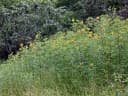
Crotalaria micans
Crotalaria micans
Safety & Hazards
This species is reported to be highly palatable and non-toxic to cattle[1]. No specific mention of toxicity has been seen for this species, but many members of this genus are known to contain pyrrolizidine alkaloids, the most potent of which in this genus are monocrotaline, retrorsine and retronecine[2]. These alkaloids have a cumulative effect upon the body and, unless concentrations in a plant are high, occasional consumption is generally completely safe. Pyrrolizidine alkaloids are derived from amino acids including ornithine. Many of these alkaloids have pronounced hepatic toxicity, but the lungs and other organs may be affected as well. Mutagenic and carcinogenic activities of pyrrolizidine alkaloids have also been reported[3].
Cultivation Details
Succeeds in the tropics and subtropics at elevations ranging from sea level to 2,600 metres, but grows best at lower elevations[4, 1]. Tolerates a wide range of climatic and soil conditions It is well suited to damp places[4]. It grows in lowland areas generally and requires a position in full sunlight[4]. Introduced in the past as an agriculture cover crop or as an ornamental, the plant can escape from cultivation and naturalize. It becomes weedy, growing along roadsides and other disturbed areas, sometimes in dense stands[5]. Seed production is poor at high elevations[4]. Early growth of the plant is fast - it can cover the soil in 3 weeks after germination and reach 2.5 metres after 3 months[4]. Seeds mature 7 months after sowing in Indonesia[4]. Plants reseed themselves once established[4]. The plant can be cut repeatedly, provided it is not cut too low and a few leaves per stem are left[4]. Yields of 40 tonnes per hectare of fresh material, 4 months after planting, have been reported from Java - this contains about 150 kg nitrogen[4]. This species has a symbiotic relationship with certain soil bacteria, these bacteria form nodules on the roots and fix atmospheric nitrogen. Some of this nitrogen is utilized by the growing plant but some can also be used by other plants growing nearby[6, 7].
Propagation
Seed - sow in situ. When broadcast, a seed rate of 20-35 kg/ha is used; 6-12 kg/ha is adequate for sowing rows 0.9-1.5 m apart. Seed - stored seed has a hard seedcoat and can benefit from scarification before sowing in order to speed up and improve germination[8]. This can usually be done by pouring a small amount of nearly boiling water on the seeds (being careful not to cook them!) and then soaking them for 12 - 24 hours in warm water. By this time they should have imbibed moisture and swollen - if they have not, then carefully make a nick in the seedcoat (being careful not to damage the embryo) and soak for a further 12 hours before sowing. Cuttings Cite as: Tropical Plants Database, Ken Fern. tropical.theferns.info. 2026-02-20. <tropical.theferns.info/viewtropical.php?id=Crotalaria+micans>
Pollinators
Insects
References
- [1]Plant Resources of Southeast Asia — http://proseanet.org/ ↩︎Lots of information on the uses of the plants of SE Asia.
- [2]The Leguminosae; A Source Book of Characteristics, Uses and Nodulation — Allen O.N.; Allen E.K. · University of Wisconsin · 1981 · ISBN 0-333-32221-5 ↩︎An amazing and comprehensive work, giving a brief guide to the many genera of the family Fabaceae and also the principle uses of the genus.
- [3]Protabase - Plant Resources of Tropical Africa. — http://www.prota.org ↩︎An excellent on-line database with detailed information on over 3,200 species of useful plants of Africa.
- [4]World Agroforesty Centre — http://www.worldagroforestry.org/ ↩︎An excellent online database of a huge range of trees giving very good information on each plant - its uses, ecology, identity, propagation, pests etc.
- [5]Pacific Island Ecosystems at Risk — http://www.hear.org/pier/scientificnames/index.html ↩︎A very good website detailing weed species that have been introduced into the Pacific Islands.
- [6]The New RHS Dictionary of Gardening. 1992. — Huxley. A. · MacMillan Press · 1992 · ISBN 0-333-47494-5 ↩︎Excellent and very comprehensive, though it contains a number of silly mistakes. Readable yet also very detailed.
- [7]Nodulation Plants in GRIN Taxonomy — United States Department of Agriculture · http://www.ars-grin.gov/~sbmljw/cgi-bin/taxnodul.pl?language=en ↩︎An online database listing plants that have either positive or negative reports on root and stem nodulation with nitrogen-fixing bacteria.
- [8]Australian Native Plants Society — http://anpsa.org.au/index.html ↩︎A series of fact sheets on Australian plants. Good photographs, brief description and information on uses, habitat, range, cultivation etc.
- [9]IUCN Red List of Threatened Species — http://www.iucnredlist.org/ ↩︎A list of plants under threat and facing possible extinction, usually with brief details of the threats and information on habitat.
- [10]Las Especies Argentinas De Crotalaria (Leguminosae - Crotalarieae): Novedades, Descripciones Y Clave — Edith Gómez-Sosa · 2000 · ISBN 0016-5301 ↩︎