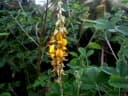
Crotalaria juncea
Crotalaria juncea
Safety & Hazards
The presence of compounds which cause unpalatability and/or are poisonous under socertainme conditions is typical of this genus. Although this plant can often contain poisonous glucosides it is commonly used as a forage[1]. The seeds of many Crotalaria species contain toxic pyrrolizidine alkaloids. Trichodesmine is the principal toxic alkaloid in Crotalaria juncea[2]. Pyrrolizidine alkaloids have a cumulative effect upon the body and, unless concentrations in a plant are high, occasional use is generally completely safe. They are derived from amino acids including ornithine. Many pyrrolizidine alkaloids have pronounced hepatic toxicity, but the lungs and other organs may be affected as well. Mutagenic and carcinogenic activities of pyrrolizidine alkaloids have also been reported[3]. The seeds are reported to contain trypsin inhibitors; they are said to be poisonous to cattle, and they can poison both horses and pigs[2].
Cultivation Details
Sunn hemp is often cultivated in the dry to moist tropics and subtropics, where it can be grown at elevations up to 1,500 metres. It grows best in areas where annual daytime temperatures are within the range 20 - 30°c, but can tolerate 4 - 40°c[4]. Mature plants can be killed by temperatures of -2°c or lower, whilst young growth will be severely damaged at -1°c[4]. It prefers a mean annual rainfall in the range 500 - 1,500mm, but tolerates 200 - 4,300mm[4]. Sun hemp is generally sensitive to photoperiod. Long day lengths favour vegetative growth and reduce seed set, although selections exist that are neutral to day length[2]. The plant is widely adaptable to different soil types, and tolerant of low fertility[2, 1]. For fibre production, a light, loamy well-drained soil is preferred; on low-lying or clay soils plants achieve vigorous growth, but the bast fibre is coarser and yields are lower[2]. Plants are not very tolerant of salty conditions[2]. Prefers a pH in the range 6 - 7, tolerating 5 - 8.4[4]. Established plants are drought resistant[2]. When grown as a fibre crop, the plants are usually harvested at the flowering stage or when the stems turn yellow. When the main priority is seed production, the crop is harvested when the seeds are ripe; the fibre is extracted from the stems afterwards[2]. The production of green plants is normally 40 - 60 tonnes/ha yielding 2.5 - 4.5 tonnes/ha of dry fibre[4]. There are no significant differences in strength and quality of fibre obtained from plants retted at flowering time and those retted when seeds are fully mature[2]. The retting period depends on water temperature, locality, time of year, weather conditions, depth and source of water, thickness of stalks, and quantity of straw in relation to volume of water. Cut straw with a yellowish tinge requires 10 - 21 days to bleach out sufficiently to have fibre of a satisfactory colour. Stems cut while green will bleach out when exposed directly to the sun but have to be turned at least twice[2]. This species has a symbiotic relationship with certain soil bacteria, these bacteria form nodules on the roots and fix atmospheric nitrogen. Some of this nitrogen is utilized by the growing plant but some can also be used by other plants growing nearby[5]. Soybean soils must contain the proper nitrogen-fixing bacteria. When grown on the same land for 2 - 3 successive years, increasing yields are obtained year after year[6]. Seed can be purchased that has been treated with this rhizobium, it is unnecessary on soils with a pH below 5.5 but can be helpful on other soils[7]. When removing plant remains at the end of the growing season, it is best to only remove the aerial parts of the plant, leaving the roots in the ground to decay and release their nitrogen.
Propagation
Seed - sown in situ. Germination is rapid and seedlings emerge 3 days after sowing, soon producing a thick ground cover that smothers weeds303]. Too much moisture is harmful during the first 2 weeks after germination[2]. Seeds are ready for harvest when pods begin to turn yellow and seeds rattle in them[2]. Cite as: Tropical Plants Database, Ken Fern. tropical.theferns.info. 2026-02-20. <tropical.theferns.info/viewtropical.php?id=Crotalaria+juncea>
Pollinators
Bees, Insects
References
- [1]Plant Resources of Southeast Asia — http://proseanet.org/ ↩︎Lots of information on the uses of the plants of SE Asia.
- [2]World Agroforesty Centre — http://www.worldagroforestry.org/ ↩︎An excellent online database of a huge range of trees giving very good information on each plant - its uses, ecology, identity, propagation, pests etc.
- [3]Protabase - Plant Resources of Tropical Africa. — http://www.prota.org ↩︎An excellent on-line database with detailed information on over 3,200 species of useful plants of Africa.
- [4]Ecocrop — http://ecocrop.fao.org/ecocrop/srv/en/home ↩︎Basic information on a wide range of useful plants, plus details of environmental needs where available.
- [5]The New RHS Dictionary of Gardening. 1992. — Huxley. A. · MacMillan Press · 1992 · ISBN 0-333-47494-5 ↩︎Excellent and very comprehensive, though it contains a number of silly mistakes. Readable yet also very detailed.
- [6]Handbook of Energy Crops — Duke. J. · - · 1983 · https://hort.purdue.edu/newcrop/duke_energy/dukeindex.html · ISBN - ↩︎Published only on the Internet, excellent information on a wide range of both temperate and tropical plants.
- [7]Oriental Vegetables — Larkcom J. · John Murray · 1991 · ISBN 0-7195-4781-4 ↩︎Well written and very informative.
- [8]Flora Zambesiaca — http://apps.kew.org/efloras/fz/intro.html ↩︎An excellent online flora of plants from the Zambezi River basin. It lists a number of the plant uses as well as the habitats and botanical descriptions of the plants.
- [9]Flora of China — Missouri Botanical Garden Press; St. Louis. · 1994 · http://flora.huh.harvard.edu/china/ ↩︎An excellent, comprehensive resource in 25 volumes. In addition to the botanical information the flora also gives basic information on habitat and some uses. An on-line version is also available.
- [10]Plants and People of Nepal — Manandhar. N. P. · Timber Press. Oregon. · 2002 · ISBN 0-88192-527-6 ↩︎Excellent book, covering over 1,500 species of useful plants from Nepal together with information on the geography and peoples of Nepal. Good descriptions of the plants with terse notes on their uses.
- [11]The Leguminosae; A Source Book of Characteristics, Uses and Nodulation — Allen O.N.; Allen E.K. · University of Wisconsin · 1981 · ISBN 0-333-32221-5 ↩︎An amazing and comprehensive work, giving a brief guide to the many genera of the family Fabaceae and also the principle uses of the genus.