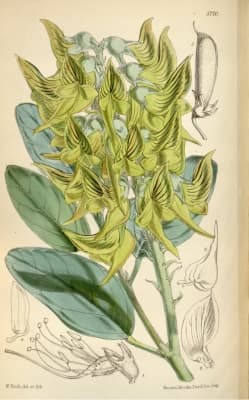
Crotalaria cunninghamii
Crotalaria cunninghamii
Safety & Hazards
No specific mention of toxicity has been seen for this species, but many members of this genus are known to contain pyrrolizidine alkaloids, the most potent of which in this genus are monocrotaline, retrorsine and retronecine[1]. These alkaloids have a cumulative effect upon the body and, unless concentrations in a plant are high, occasional consumption is generally completely safe. Pyrrolizidine alkaloids are derived from amino acids including ornithine. Many of these alkaloids have pronounced hepatic toxicity, but the lungs and other organs may be affected as well. Mutagenic and carcinogenic activities of pyrrolizidine alkaloids have also been reported[2].
Cultivation Details
Crotalaria cunninghamii is a plant of arid and semi-arid regions of Australia from the warm temperate zone to the tropics. Requires a sunny position and a well-drained soil, growing in the wild on sandy soils[3, 4]. This species has a symbiotic relationship with certain soil bacteria; these bacteria form nodules on the roots and fix atmospheric nitrogen. Some of this nitrogen is utilized by the growing plant but some can also be used by other plants growing nearby[1].
Propagation
Seed - it has a hard seedcoat and benefits from scarification before sowing in order to speed up and improve germination[4]. This can usually be done by pouring a small amount of nearly boiling water on the seeds (being careful not to cook them!) and then soaking them for 12 - 24 hours in warm water. By this time they should have imbibed moisture and swollen - if they have not, then carefully make a nick in the seedcoat (being careful not to damage the embryo) and soak for a further 12 hours before sowing. Cuttings Cite as: Temperate Plants Database, Ken Fern. temperate.theferns.info. 2026-02-21. <temperate.theferns.info/plant/Crotalaria+cunninghamii>
Pollinators
Insects
References
- [1]The Leguminosae; A Source Book of Characteristics, Uses and Nodulation — Allen O.N.; Allen E.K. · University of Wisconsin · 1981 · ISBN 0-333-32221-5 ↩︎An amazing and comprehensive work, giving a brief guide to the many genera of the family Fabaceae and also the principle uses of the genus.
- [2]Protabase - Plant Resources of Tropical Africa. — http://www.prota.org ↩︎An excellent on-line database with detailed information on over 3,200 species of useful plants of Africa.
- [3]IUCN Red List of Threatened Species — http://www.iucnredlist.org/ ↩︎A list of plants under threat and facing possible extinction, usually with brief details of the threats and information on habitat.
- [4]Australian Native Plants Society — http://anpsa.org.au/index.html ↩︎A series of fact sheets on Australian plants. Good photographs, brief description and information on uses, habitat, range, cultivation etc.
- [5]Flora of New South Wales — http://plantnet.rbgsyd.nsw.gov.au/floraonline.htm ↩︎An on-line resource giving a brief botanical description of all the native plants of New South Wales, their habitat and range, together with diagrams and photographs of the plants.