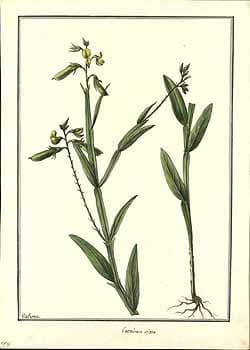
Crotalaria alata
Crotalaria alata
Safety & Hazards
The plant has been reported as suitable for fodder, but in Queensland it is considered poisonous for cattle[1]. Monocrotaline in the seeds may cause death in poultry[1]. Many members of this genus are known to contain pyrrolizidine alkaloids, the most potent of which in this genus are monocrotaline, retrorsine and retronecine[2]. These alkaloids have a cumulative effect upon the body and, unless concentrations in a plant are high, occasional consumption is generally completely safe. Pyrrolizidine alkaloids are derived from amino acids including ornithine. Many of these alkaloids have pronounced hepatic toxicity, but the lungs and other organs may be affected as well. Mutagenic and carcinogenic activities of pyrrolizidine alkaloids have also been reported[3].
Cultivation Details
The plant is found in areas with a pronounced monsoonal climate, growing mainly at low elevations, but also ascending to 1,500 metres[1]. Plants in this genus generally prefer a sunny position, succeeding in dry to moist, well-drained soils[4]. The plant is tolerant of shade[1]. The plant is often found as a weed[1]. A deep-rooting plant[1]. Plants are tolerant of fire[1]. This species has a symbiotic relationship with certain soil bacteria; these bacteria form nodules on the roots and fix atmospheric nitrogen. Some of this nitrogen is utilized by the growing plant but some can also be used by other plants growing nearby[2].
Propagation
Seed - sow in situ. Pre-soaking the seed for 12 hours in warm water can help to reduce germination time. Cite as: Tropical Plants Database, Ken Fern. tropical.theferns.info. 2026-02-20. <tropical.theferns.info/viewtropical.php?id=Crotalaria+alata>
Pollinators
Data unavailable
References
- [1]Plant Resources of Southeast Asia — http://proseanet.org/ ↩︎Lots of information on the uses of the plants of SE Asia.
- [2]The Leguminosae; A Source Book of Characteristics, Uses and Nodulation — Allen O.N.; Allen E.K. · University of Wisconsin · 1981 · ISBN 0-333-32221-5 ↩︎An amazing and comprehensive work, giving a brief guide to the many genera of the family Fabaceae and also the principle uses of the genus.
- [3]Protabase - Plant Resources of Tropical Africa. — http://www.prota.org ↩︎An excellent on-line database with detailed information on over 3,200 species of useful plants of Africa.
- [4]The New RHS Dictionary of Gardening. 1992. — Huxley. A. · MacMillan Press · 1992 · ISBN 0-333-47494-5 ↩︎Excellent and very comprehensive, though it contains a number of silly mistakes. Readable yet also very detailed.
- [5]Plants and People of Nepal — Manandhar. N. P. · Timber Press. Oregon. · 2002 · ISBN 0-88192-527-6 ↩︎Excellent book, covering over 1,500 species of useful plants from Nepal together with information on the geography and peoples of Nepal. Good descriptions of the plants with terse notes on their uses.
- [6]Mansfeld's Database of Agricultural and Horticultural Plants — http://mansfeld.ipk-gatersleben.de/pls/htmldb_pgrc/f?p=185:3:4292127278597336 ↩︎Terse details of a huge range of useful plants.
- [7]A revision of the Genus Crotalaria Linn. (Papilionaceae) in Thailand — Chawalit Niyomdham · 1978 ↩︎