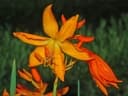
Crocosmia aurea
Crocosmia aurea
Safety & Hazards
None known
Cultivation Details
Crocosmia aurea is native from the warm temperate to the tropical zones of southern Africa. The corms are hardy to about -10°c[1] but in cold areas it is wise to lift them when the plants die down in the autumn, store them in a cool frost-free place over the winter and plant them out in the spring[2]. Make sure the corms do not dry out[2]. It is best to avoid lifting the corms if at all possible since the new corms seem to derive some nutrition from the old corms that have flowered[1]. A very easily grown plant, it succeeds in almost all soils other than very heavy clays or bogs[3], though it prefers a light rich sandy soil[2, 4] in full sun or light dappled shade[1, 3]. Another report says that it prefers a fairly shady position and plenty of moisture in the growing season[4]. Plants can divide quite freely when growing in a suitable location[3]. Although the fresh flowers have no perfume, when dried and immersed in warm water they release a scent like that of the saffron crocus[5]. Members of this genus are rarely if ever troubled by browsing deer or rabbits[3].
Propagation
Seed - best sown as soon as it is ripe in a cold greenhouse[2]. The seed usually germinates in 3 - 9 weeks at 20 - 25°c[6]. Stored seed can be sown in early spring in a greenhouse[6]. Sow the seed thinly so that the plants can be grown on undisturbed in their pot for the first year, but give the seedlings an occasional liquid feed to ensure they do not become nutrient deficient. Once the plants are dormant in the autumn, pot up the bulbs putting 2 - 3 bulbs in each pot. Grow them on for another year or two in the greenhouse before planting them out when they are dormant in the autumn. Division in spring as new growth commences[1]. Very easy, larger clumps can be replanted direct into their permanent positions, though it is best to pot up smaller clumps and grow them on in a cold frame until they are rooting well. Plant them out in the summer or following spring. Cite as: Temperate Plants Database, Ken Fern. temperate.theferns.info. 2026-02-21. <temperate.theferns.info/plant/Crocosmia+aurea>
Pollinators
Insects
References
- [1]The New RHS Dictionary of Gardening. 1992. — Huxley. A. · MacMillan Press · 1992 · ISBN 0-333-47494-5 ↩︎Excellent and very comprehensive, though it contains a number of silly mistakes. Readable yet also very detailed.
- [2]RHS Dictionary of Plants plus Supplement. 1956 — F. Chittendon. · Oxford University Press · 1951 · ISBN - ↩︎Comprehensive listing of species and how to grow them. Somewhat outdated, it has been replaced in 1992 by a new dictionary (see [ 200 ]).
- [3]Perennial Garden Plants — Thomas. G. S. · J. M. Dent & Sons, London. · 1990 · ISBN 0 460 86048 8 ↩︎A concise guide to a wide range of perennials. Lots of cultivation guides, very little on plant uses.
- [4]The World of Iridaceae — Innes. C. ↩︎Deals with many of the plants in the Iris family giving brief details of habitat and notes on cultivation. Well illustrated.
- [5]Scented Flora of the World. — Genders. R. · Robert Hale. London. · 1994 · ISBN 0-7090-5440-8 ↩︎An excellent, comprehensive book on scented plants giving a few other plant uses and brief cultivation details. There are no illustrations.
- [6]Growing from Seed. Volume 4. — Bird. R. (Editor) · Thompson and Morgan. · 1990 · ISBN - ↩︎Very readable magazine with lots of information on propagation. A good article on Yuccas, one on Sagebrush (Artemesia spp) and another on Chaerophyllum bulbosum.
- [7]PlantZAfrica.com — http://www.plantzafrica.com ↩︎An excellent site giving detailed descriptions and uses of many S. African plants.
- [8]Bulbs — Phillips. R. and Rix. M. · Pan Books · 1989 · ISBN 0-330-30253-1 ↩︎Superbly illustrated, it gives brief details on cultivation and native habitat.
- [9]Flora Zambesiaca — http://apps.kew.org/efloras/fz/intro.html ↩︎An excellent online flora of plants from the Zambezi River basin. It lists a number of the plant uses as well as the habitats and botanical descriptions of the plants.
- [10]A Dictionary of Plants Used by Man. — Usher. G. · Constable · 1974 · ISBN 0094579202 ↩︎Forget the sexist title, this is one of the best books on the subject. Lists a very extensive range of useful plants from around the world with very brief details of the uses. Not for the casual reader.
- [11]Plants for Human Consumption. — Kunkel. G. · Koeltz Scientific Books · 1984 · ISBN 3874292169 ↩︎An excellent book for the dedicated. A comprehensive listing of Latin names with a brief list of edible parts.
- [12]Cornucopia - A Source Book of Edible Plants. — Facciola. S. · Kampong Publications · 1990 · ISBN 0-9628087-0-9 ↩︎Excellent. Contains a very wide range of conventional and unconventional food plants (including tropical) and where they can be obtained (mainly N. American nurseries but also research institutes and a lot of other nurseries from around the world.