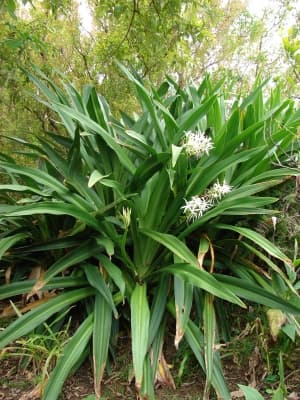
Cultivation Details
Crinum asiaticum is a plant of mainly subtropical and tropical regions of Asia and Australasia, growing mainly near the coast. Plants are not very cold hardy, tolerating occasional lows down to about -5°c[4]. In regions at the limits of their cold hardiness, they are best given the protection of a south or southwest facing wall. Plant the bulbs shallowly, with the neck of the bulb at soil level, and give a protective mulch of bracken or compost in the winter[4]. Prefers a deep, well-drained but moisture-retentive fertile soil that is rich in organic matter[4]. Succeeds in full sun or partial shade[3]. The bulbs must have sufficient moisture during the growing season[4]. Plants grow well near the sea[3]. A robust and very variable species[1]. It can flower and fruit all year round in some areas[5, 6]. Bulbs are sensitive to transplanting and can take several years to become established. After this, they will usually reproduce rapidly from offsets to produce the overcrowded conditions that stimulate them to flower freely[4].
Propagation
Seed - best sown as soon as it is ripe, placing 2 - 3 seeds in individual pots in a greenhouse. Do not cover the seed. Sow stored seed mid spring in a warm greenhouse. Once they have germinated, you can thin each pot to just one plant if required, though we have not found this to be necessary. Give an occasional liquid feed to ensure that the plants do not suffer nutritional deficiencies. Grow them on in the greenhouse for at least their first 2 years, planting them out into their permanent positions in the spring. Division of offsets in mid spring or in September. When divided in the spring, the bulbs can be planted out direct into their permanent positions, if done in September, however, they should be potted up and overwintered in the greenhouse. Cite as: Temperate Plants Database, Ken Fern. temperate.theferns.info. 2026-02-21. <temperate.theferns.info/plant/Crinum+asiaticum>
Pollinators
Insects
References
- [1]Flora of N. America — http://flora.huh.harvard.edu/fna/ ↩︎An on-line version of the flora with an excellent description of the plant including a brief mention of plant uses.
- [2]Encyclopedia of Tropical Plants - Identification and Cultivation of over 3,000 Tropical Plants — Ahmed Fayaz · Firefly Books Ltd.; New Zealand · 2011 · ISBN 978-1-55407-489 ↩︎A good photograph and terse but detailed information for over 3,000 species of tropical plants. An excellent reference.
- [3]Tropical Ornamentals; A Guide — Whistler. W. Arthur. · Timber Press Inc. Oregon. · 2000 · ISBN 0-88192-448-2 ↩︎An excellent little guide to some of the more commonly cultivated ornamental plants of the Tropics, often giving some information on the plants other uses.
- [4]The New RHS Dictionary of Gardening. 1992. — Huxley. A. · MacMillan Press · 1992 · ISBN 0-333-47494-5 ↩︎Excellent and very comprehensive, though it contains a number of silly mistakes. Readable yet also very detailed.
- [5]Pacific Island Ecosystems at Risk — http://www.hear.org/pier/scientificnames/index.html ↩︎A very good website detailing weed species that have been introduced into the Pacific Islands.
- [6]Medicinal Plants in Papua New Guinea — World Health Organisation · 2009 · ISBN 978-92-9061-249-0 ↩︎Traditional medicinal uses of 126 species from Papua New Guinea, including information on modern research into the plants.
- [7]Plant Resources of Southeast Asia — http://proseanet.org/ ↩︎Lots of information on the uses of the plants of SE Asia.
- [8]The Useful Plants of the Island of Guam — Safford W.E. · Smithsonian Institute; Washington. · 1905 · http://www.biodiversitylibrary.org/ ↩︎A very comprehensive, if rather dated, guide to the plants of Guam. It can be downloaded from the Internet.
- [9]Flora of China — Missouri Botanical Garden Press; St. Louis. · 1994 · http://flora.huh.harvard.edu/china/ ↩︎An excellent, comprehensive resource in 25 volumes. In addition to the botanical information the flora also gives basic information on habitat and some uses. An on-line version is also available.
- [10]Medicinal Plants in Vietnam — Nguyen Van Dan & Doan Thi Nhu · World Health Organisation · 1989 · ISBN 92 9061 101 4 ↩︎An excellent book, giving information on over 200 plants, their medicinal compounds and applications.
- [11]Medicinal Plants in the South Pacific — WHO Regional Publications, Manilla. · 1998 · ISBN 92-9061-118-9 ↩︎Excellent guide to 102 medicinal herbs of the Pacific Islands, with photographs of each plant and details of their constituents, biological activities and traditional uses. A description of each plant, together with habitat and distribution is given.