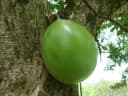
Cultivation Details
A plant of the lowland tropics. Prefers a fertile, moist soil in a sunny position[1]. Established plants are very drought tolerant[2]. Plants do not flower until they are quite large[3], then they can flower all year round[2]. The flowers emit a pungent, musky, cabbage scent in the evenings[2]. The large fruits have nectaries that are believed to attract stinging ants. These ants then ward off herbivores such as goats[2]. The trees seem to afford a particularly good habitat for epiphytes, and in the wild they often are covered with orchids, bromeliads, and other plants[2, 4]. Blocks of the wood, used for mounting epiphytic plants, are sold commercially[2].
Propagation
Seed - Air-layering. Cuttings. Cite as: Tropical Plants Database, Ken Fern. tropical.theferns.info. 2026-02-20. <tropical.theferns.info/viewtropical.php?id=Crescentia+cujete>
Pollinators
Bats
References
- [1]Tropical Ornamentals; A Guide — Whistler. W. Arthur. · Timber Press Inc. Oregon. · 2000 · ISBN 0-88192-448-2 ↩︎An excellent little guide to some of the more commonly cultivated ornamental plants of the Tropics, often giving some information on the plants other uses.
- [2]Tropical and Subtropical Trees - A Worldwide Encyclopaedic Guide. — Barwick. M. · Thames & Hudson, London · 2004 · ISBN 0-500-51181-0 ↩︎A superb book, very concise and well written, giving a wealth of information on 400 or more species including descriptions, habitat, cultivation details and plant uses. A wealth of colour photographs bring each plant vividly to life.
- [3]The New RHS Dictionary of Gardening. 1992. — Huxley. A. · MacMillan Press · 1992 · ISBN 0-333-47494-5 ↩︎Excellent and very comprehensive, though it contains a number of silly mistakes. Readable yet also very detailed.
- [4]Flora of Guatemala — Standley P.C. & J. A. Steyermark · 1946 - 1976 · http://www.archive.org/ ↩︎A superb reference, though somewhat dated. Gives lots of plant uses as well as information on plant habit and habitat. The entire flora (13 volumes) can now be downloaded from http://www.archive.org/
- [5]Bignoniaceae Part 1 (Crescentieae and Tourrettieae) — Gentry A.H. · The New York Botanical Garden, New York · 1980 · ISBN 0-89327-222-1 ↩︎
- [6]IUCN Red List of Threatened Species — http://www.iucnredlist.org/ ↩︎A list of plants under threat and facing possible extinction, usually with brief details of the threats and information on habitat.
- [7]Flowering Plants of Jamaica — Adams. C.D. · University of the West Indies; Jamaica. · 1972 ↩︎A terse treatment of the flowering plants of Jamaica, with a botanical description of each plant, notes on habitat etc.
- [8]Cornucopia II — Facciola. S. · Kampong Publications, California. · 1998 · ISBN 0-9628087-2-5 ↩︎The second edition of an excellent guide to the edible uses of plants, though it does not give any details of cultivation etc.
- [9]Dictionary of Economic Plants. — Uphof. J. C. Th. · Weinheim · 1959 · ISBN - ↩︎An excellent and very comprehensive guide but it only gives very short descriptions of the uses without any details of how to utilize the plants. Not for the casual reader.
- [10]Annals of the Missouri Botanical Garden Vol. 79 — van der Werff H. (Editor) · Missouri Botanical Garden; St. Louis. · 1992 · http://www.biodiversitylibrary.org · ISBN 0026-6493 ↩︎A botanical journal, it includes an article on the ethnobotanical uses of the plant family Bignoniaceae. It can be downloaded from the Internet.
- [11]Medicinal Plants of the Guianas — DeFilipps, R. A.; Maina, S. L.; & Crepin, J. · Smithsonian Museum · http://botany.si.edu/bdg/medicinal/index.html ↩︎A down-loadable PDF document of a book in pre-publication awaiting illustration. An excellent, if rather terse, guide to the traditional medicinal uses of the plants of the region
- [12]Plant Resources of Southeast Asia — http://proseanet.org/ ↩︎Lots of information on the uses of the plants of SE Asia.
- [13]Medicinal Plants of the Andes and the Amazon: The magic and medicinal flora of Northern Peru — Bussmann R.W. & Sharon D. · 2015 · ISBN 10:0-9960231-2-7 ↩︎An introduction to traditional herbalism in Peru plus brief information on the medicinal uses of
- [PFAF]Plants for a Future — pfaf.org ↩︎