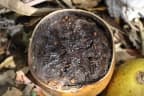
Bignoniaceae FAMILY Least Concern
Crescentia alata
Crescentia alata
Edibility
2/5
Medicinal
2/5
Safety & Hazards
None known
Cultivation Details
HabitTree
GrowthFast
Crescentia alata is native to the tropics of Central America, where it can be found at elevations up to 1,200 metres. It is said to grow best in areas where the mean daily temperature can range between 18 - 29°c, and the mean annual rainfall between 400 - 900mm[1]. Grows best in a deep, well-drained soil of moderate fertility[1]. Established plants have a good resistance to drought[1]. Young plants are fast-growing and establish well[1]. The flowers have a musky aroma[2].
Propagation
Seed - Cite as: Tropical Plants Database, Ken Fern. tropical.theferns.info. 2026-02-20. <tropical.theferns.info/viewtropical.php?id=Crescentia+alata>
Pollinators
Bats
References
- [1]Establishment, growth and biomass production of 10 tree woody species introduced for reforestation and ecological re — Foroughbakhch R. et al · 2006 · http://10.1016/j.foreco.2006.08.012 ↩︎
- [2]Bignoniaceae Part 1 (Crescentieae and Tourrettieae) — Gentry A.H. · The New York Botanical Garden, New York · 1980 · ISBN 0-89327-222-1 ↩︎
- [3]Flora of Guatemala — Standley P.C. & J. A. Steyermark · 1946 - 1976 · http://www.archive.org/ ↩︎A superb reference, though somewhat dated. Gives lots of plant uses as well as information on plant habit and habitat. The entire flora (13 volumes) can now be downloaded from http://www.archive.org/
- [4]Mansfeld's Database of Agricultural and Horticultural Plants — http://mansfeld.ipk-gatersleben.de/pls/htmldb_pgrc/f?p=185:3:4292127278597336 ↩︎Terse details of a huge range of useful plants.
- [5]IUCN Red List of Threatened Species — http://www.iucnredlist.org/ ↩︎A list of plants under threat and facing possible extinction, usually with brief details of the threats and information on habitat.
- [6]Dictionary of Economic Plants. — Uphof. J. C. Th. · Weinheim · 1959 · ISBN - ↩︎An excellent and very comprehensive guide but it only gives very short descriptions of the uses without any details of how to utilize the plants. Not for the casual reader.
- [7]Trees and Shrubs of Mexico — Standley P.C. · Smithsonian Institution; Washington · 1926 ↩︎Although dated, it contains a wealth of information on the trees and shrubs of Mexico, including many of their uses. It can be downloaded from the Internet.
- [8]Cornucopia II — Facciola. S. · Kampong Publications, California. · 1998 · ISBN 0-9628087-2-5 ↩︎The second edition of an excellent guide to the edible uses of plants, though it does not give any details of cultivation etc.
- [9]Plant Resources of Southeast Asia — http://proseanet.org/ ↩︎Lots of information on the uses of the plants of SE Asia.
- [10]Minor Products of Philippine Forests — Brown. W. H. · Bureau of Forestry, Manilla. · 1920 ↩︎A useful guide to some of the plants of the area, though terse on details. The book is out of copyright and can be legally downloaded from the Internet.
- [11]Annals of the Missouri Botanical Garden Vol. 79 — van der Werff H. (Editor) · Missouri Botanical Garden; St. Louis. · 1992 · http://www.biodiversitylibrary.org · ISBN 0026-6493 ↩︎A botanical journal, it includes an article on the ethnobotanical uses of the plant family Bignoniaceae. It can be downloaded from the Internet.