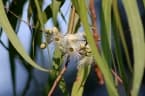
Corymbia citriodora
Corymbia citriodora
Safety & Hazards
None known
Cultivation Details
Corymbia citriodora is native from the tropical climate of eastern Queensland to the subtropical and warm temperate regions of northern New South Wales. It is usually found in areas where the summers are hot (it can withstand a mean monthly maximum of 29 - 35°c) and any winter is generally mild. It is not a very cold-hardy plant, but succeeds in areas where frosts are occasional and generally light. It can succeed in arid to semiarid zones, though is said to grow best where the mean annual rainfall, falling mostly in the summer, is within the range 600 - 1,300mm, with a 5 - 7 month dry season[1]. Prefers a sunny position in a moderately fertile well-drained moisture retentive circum-neutral soil[2]. Tolerates poor and dry soils, especially those low in mineral elements[2].Plants can be grown in infertile clays, laterites, poor and gravelly soils and podzols, preferably well drained[1]. Established plants are drought tolerant[2]. Does not succeed in frost hollows or in windy sites[3]. The plant develops a lignotuber - this is a woody tuber that starts to develop near the base of seedlings and can become massive in the mature plants of some species. It possesses embedded vegetative buds, allowing the plant to regenerate following crown destruction, for example by fire[4]. A very fast growing species[5]. Flowering usually starts within 2 years after planting and seeds are produced abundantly by 5 years of age[6]. This species is often cultivated from warm temperate areas to the tropics for its essential oil; it especially thrives in a Mediterranean climate[7, 8]. The leaves are strongly lemon-scented when crushed[6]. When grown for fuel, yields of 10 - 21 cubic metres per hectare per year have been obtained[1]. Whilst most Corymbia species, grown in small numbers outside their native range, can be an attractive and useful addition to the landscape, certain species (including this one) are more problematic. When grown in monocultures, especially outside their native range, they can become an environmental disaster. They are voracious, especially in their use of water; they are allelopathic, inhibiting the growth of the native flora; they reduce habitats for native fauna; and encourage the worst possible attitudes to land use and conservation[2]. The trees cast a very light shade[8]. Flower buds are formed in the summer prior to flowering and seed capsules need at least a further year in which to ripen[9]. Plants are shallow-rooting and, especially in windy areas, should be planted out into their permanent positions when small to ensure that they do not suffer from wind-rock[10]. They strongly resent root disturbance and should be container grown before planting out into their permanent position[9]. Corymbia species have not adopted a deciduous habit and continue to grow until it is too cold for them to do so. This makes them more susceptible to damage from sudden cold snaps. If temperature fluctuations are more gradual, as in a woodland for example, the plants have the opportunity to stop growing and become dormant, thus making them more cold resistant. A deep mulch around the roots to prevent the soil from freezing also helps the trees to survive cold conditions[2]. Many members of this genus are remarkably adaptable however, and there can be a dramatic increase in the hardiness of subsequent generations from the seed of survivors growing in temperate zones[2].
Propagation
Seed - surface sow late winter/early spring in a sunny position in a greenhouse[9, 11, 12]. Species that come from high altitudes appreciate 6 - 8 weeks cold stratification at 2°c[2]. Pot up the seedlings into individual pots as soon as the second set of seed leaves has developed, if left longer than this they might not move well. Plant out into their permanent positions in early summer and give them some protection from the cold in their first winter. The seed can also be sown in early summer, the young trees being planted in their final positions in late spring of the following year. The seed has a long viability[2]. Cite as: Temperate Plants Database, Ken Fern. temperate.theferns.info. 2026-02-21. <temperate.theferns.info/plant/Corymbia+citriodora>
Pollinators
Bees, Insects
References
- [1]Handbook of Energy Crops — Duke. J. · - · 1983 · https://hort.purdue.edu/newcrop/duke_energy/dukeindex.html · ISBN - ↩︎Published only on the Internet, excellent information on a wide range of both temperate and tropical plants.
- [2]The New RHS Dictionary of Gardening. 1992. — Huxley. A. · MacMillan Press · 1992 · ISBN 0-333-47494-5 ↩︎Excellent and very comprehensive, though it contains a number of silly mistakes. Readable yet also very detailed.
- [3]A Key to Eucalypts in Britain and Ireland. — Brooker. M. I. · HMSO · 1983 · ISBN 0-11-710192-3 ↩︎A Forestry commission booklet giving details of the more common Eucalyptus species grown in Britain. Good identification guide.
- [4]EUCLID - Eucalypts of Australia — Centre for Australian National Biodiversity Research, Canber · http://keyserver.lucidcentral.org:8080/euclid/data/02050e02-0108-490e-8900-0e0601070d00/media/Html/index.htm ↩︎A website dedicated to the genus Eucalyptus (sensu latu), with descriptions and nomencultural information on all the species.
- [5]The Milder Garden. — Taylor. J. · Dent · 1990 ↩︎A good book on plants that you didn't know could be grown outdoors in Britain.
- [6]World Agroforesty Centre — http://www.worldagroforestry.org/ ↩︎An excellent online database of a huge range of trees giving very good information on each plant - its uses, ecology, identity, propagation, pests etc.
- [7]A Dictionary of Plants Used by Man. — Usher. G. · Constable · 1974 · ISBN 0094579202 ↩︎Forget the sexist title, this is one of the best books on the subject. Lists a very extensive range of useful plants from around the world with very brief details of the uses. Not for the casual reader.
- [8]Eucalypts. (2 volumes.) — Kelly. S. · Nelson, Melbourne · 1969 · ISBN - ↩︎A very readable book (in two volumes) on the many species of Eucalyptus trees in Australia.
- [9]Trees and Shrubs Hardy in Great Britain. Vol 1 - 4 and Supplement. — Bean. W. · Murray · 1981 · ISBN - ↩︎A classic with a wealth of information on the plants, but poor on pictures.
- [10]Scented Flora of the World. — Genders. R. · Robert Hale. London. · 1994 · ISBN 0-7090-5440-8 ↩︎An excellent, comprehensive book on scented plants giving a few other plant uses and brief cultivation details. There are no illustrations.
- [11]Propagation of Trees, Shrubs and Conifers. — Sheat. W. G. · MacMillan and Co · 1948 · ISBN - ↩︎A bit dated but a good book on propagation techniques with specific details for a wide range of plants.
- [12]Growing from Seed. Volume 2. — Rice. G. (Editor) · Thompson and Morgan. · 1988 · ISBN - ↩︎Very readable magazine with lots of information on propagation. An interesting article on Ensete ventricosum.
- [13]Economic Native Plants of New Zealand. — Brooker. S. G., Cambie. R. C. and Cooper. R. C. · Oxford University Press · 1991 · ISBN 0-19-558229-2 ↩︎An interesting and readable book on the useful plants of New Zealand.
- [14]Cornucopia - A Source Book of Edible Plants. — Facciola. S. · Kampong Publications · 1990 · ISBN 0-9628087-0-9 ↩︎Excellent. Contains a very wide range of conventional and unconventional food plants (including tropical) and where they can be obtained (mainly N. American nurseries but also research institutes and a lot of other nurseries from around the world.
- [15]The Encyclopedia of Medicinal Plants — Chevallier. A. · Dorling Kindersley. London · 1996 · ISBN 9-780751-303148 ↩︎An excellent guide to over 500 of the more well known medicinal herbs from around the world.
- [16]Native Tastes of Australia — http://tasteaustralia.biz/ ↩︎A website with detailed information on around 50 species of native Australian food plants, including recipes.
- [17]Australian Medicinal Plants. — Lassak. E. V. and McCarthy. T. · New Holland Publishers · 2001 · ISBN 1876334703 ↩︎A very good and readable guide to the subject.
- [18]A Modern Herbal. — Grieve. · Penguin · 1984 · ISBN 0-14-046-440-9 ↩︎Not so modern (1930's?) but lots of information, mainly temperate plants.
- [19]Encyclopaedia of Herbs and their Uses. — Bown. D. · Dorling Kindersley, London. · 1995 · ISBN 0-7513-020-31 ↩︎A very well presented and informative book on herbs from around the globe. Plenty in it for both the casual reader and the serious student. Just one main quibble is the silly way of having two separate entries for each plant.
- [20]Dictionary of Economic Plants. — Uphof. J. C. Th. · Weinheim · 1959 · ISBN - ↩︎An excellent and very comprehensive guide but it only gives very short descriptions of the uses without any details of how to utilize the plants. Not for the casual reader.
- [21]Glossary of Indian Medicinal Plants (Including the Supplement). — Chopra. R. N., Nayar. S. L. and Chopra. I. C. · Council of Scientific and Industrial Research, New Delhi. · 1986 · ISBN - ↩︎Very terse details of medicinal uses of plants with a wide range of references and details of research into the plants chemistry. Not for the casual reader.
- [22]Useful Wild Plants in Australia. — Cribb. A. B. and J. W. · William Collins Pty Ltd. Sidney · 1981 · ISBN 0-00-216441-8 ↩︎A very readable book.
- [23]CosIng — http://ec.europa.eu/growth/tools-databases/cosing/ ↩︎CosIng is the European Commission database for information on cosmetic substances and ingredients.