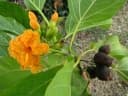
Cordia subcordata
Cordia subcordata
Safety & Hazards
None known
Cultivation Details
A plant of the tropical coasts, it grows best in areas where the annual precipitation is around 1,250mm[1]. Prefers a moist, but well-drained soil and a position in full sun[2]. It is suited for planting on sandy soils and can grow well in subhumid climates[1]. Plants are reasonably tolerant of saline soils and also of some exposure to salt spray, though heavy salt spray can severely damage leaves[3]. Young plants are not very shade tolerant but can develop reasonably well under light conditions above 30% relative light intensity[1]. Established plants are moderately drought resistant[3]. Trees grow fast on moderately fertile and well-drained sites. It has been reported from Buru (Indonesia) that young plants of C. subcordata can reach a height of 1.1 - 1.5 metres 10 months after planting on good sites. In East Java trees were 4 - 5 metres tall in a 2-year-old plantation and on average 7 metres tall after 4 years with an average diameter of 6.5cm[1]. Plants can flower and fruit all year round[4]. Plants of 3 years old may already produce fruits. The fruits of this species are probably dispersed by ocean currents; they have a hard stone and corky tissue[1]. Plants have a shallow root system and can be damaged by too much surface disturbance[3].
Propagation
Seed - seeds are reported to take 19 - 62 days to germinate, with about 25% of the seeds being viable[1]. However, data from Indonesia show that viability may be as high as 90-100%, but seed collected from the ground showed 40-50% germination[1]. The germination process can be sped up if the seed is first scarified by lightly abrading the seedcoat to allow easier ingress of water[5]. Storage under ambient conditions reduces the viability from 60% initially to 40% after 7 months[1]. It is recommended to sow the seeds 1.5-2 cm deep, pointing downwards[1]. Seedlings should be watered sparingly[1]. Cite as: Tropical Plants Database, Ken Fern. tropical.theferns.info. 2026-02-20. <tropical.theferns.info/viewtropical.php?id=Cordia+subcordata>
Pollinators
Insects
References
- [1]World Agroforesty Centre — http://www.worldagroforestry.org/ ↩︎An excellent online database of a huge range of trees giving very good information on each plant - its uses, ecology, identity, propagation, pests etc.
- [2]The New RHS Dictionary of Gardening. 1992. — Huxley. A. · MacMillan Press · 1992 · ISBN 0-333-47494-5 ↩︎Excellent and very comprehensive, though it contains a number of silly mistakes. Readable yet also very detailed.
- [3]Native Plants Hawaii — http://nativeplants.hawaii.edu/plant/ ↩︎A website containing information on a range of native Hawaiian plants, with descriptions, habitat, traditional uses etc.
- [4]Flowers of India — http://www.flowersofindia.net/ ↩︎A wed site of native Indian plants, plus cultivated and naturalized species. It has good quality photos and terse details on more than 3,000 species and cultivars.
- [5]Tropical and Subtropical Trees - A Worldwide Encyclopaedic Guide. — Barwick. M. · Thames & Hudson, London · 2004 · ISBN 0-500-51181-0 ↩︎A superb book, very concise and well written, giving a wealth of information on 400 or more species including descriptions, habitat, cultivation details and plant uses. A wealth of colour photographs bring each plant vividly to life.
- [6]Protabase - Plant Resources of Tropical Africa. — http://www.prota.org ↩︎An excellent on-line database with detailed information on over 3,200 species of useful plants of Africa.
- [7]Mansfeld's Database of Agricultural and Horticultural Plants — http://mansfeld.ipk-gatersleben.de/pls/htmldb_pgrc/f?p=185:3:4292127278597336 ↩︎Terse details of a huge range of useful plants.
- [8]IUCN Red List of Threatened Species — http://www.iucnredlist.org/ ↩︎A list of plants under threat and facing possible extinction, usually with brief details of the threats and information on habitat.
- [9]Flora Zambesiaca — http://apps.kew.org/efloras/fz/intro.html ↩︎An excellent online flora of plants from the Zambezi River basin. It lists a number of the plant uses as well as the habitats and botanical descriptions of the plants.
- [10]Flora of China — Missouri Botanical Garden Press; St. Louis. · 1994 · http://flora.huh.harvard.edu/china/ ↩︎An excellent, comprehensive resource in 25 volumes. In addition to the botanical information the flora also gives basic information on habitat and some uses. An on-line version is also available.
- [11]Fruits of the Guianan Flora — van Roosmalen. M.G.M. · Institute of Systematic Boyany, Utrecht University; Netherlands. · 1985 · ISBN 90-9000988-4 ↩︎Terse descriptions of over 1,700 species from the Guianas that bear fruits - not necessarily edible! Often mentions if the fruit is edible, plus gives brief description of habit and habitat.
- [12]Plants of Guam — Moore P.H. & McMakin P. · University of Guam. · 1979 · http://university.uog.edu/cals/people/POG/scipn.htm ↩︎Brief details, usually with a photo, of plants native to the island of Guam, often together with some information on their uses. An online version is available.
- [PFAF]Plants for a Future — pfaf.org ↩︎