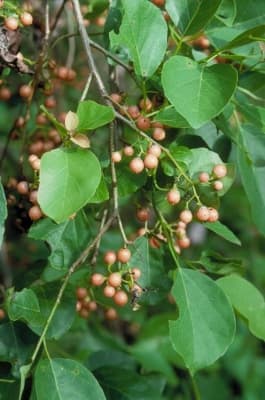
Cordia myxa
Cordia myxa
Safety & Hazards
None known
Cultivation Details
Plants can succeed in warm temperate to tropical areas[1]. It can tolerate some frost[2]. Plants prefer a sunny position, but can tolerate moderate shade[2]. Prefers a moist, freely-draining loamy soil[3]. Established plants are drought tolerant[2]. The plant often escapes from cultivation[4]. This report does not make clear whether it invades and harms native environments[PFAF]. A fairly fast-growing pant, it can commence flowering when 3 - 5 years old[2]. In arid regions in India, a plantation of eight year-old trees yielded on average 32.4 kg fruits per tree per year. Individual fruits weigh about 5g[2]. Plants can be coppiced and pollarded[2]. Dioecious, at least one male plant must be grown with 5 females in order to produce fruit and seed.
Propagation
Seed - very slow to germinate, the process can be sped up if the seed is scarified by lightly abrading the seedcoat to allow easier ingress of water[1]. Pre-soak the seed in cold water for 6 hours before sowing - a germination rate of 50 - 80% can be expected, with the seed sprouting within 40 - 60 days[2]. Young plants can be planted in their permanent positions 4 - 6 months later[2]. Cuttings. Cite as: Tropical Plants Database, Ken Fern. tropical.theferns.info. 2026-02-20. <tropical.theferns.info/viewtropical.php?id=Cordia+myxa>
Pollinators
Insects
References
- [1]Tropical and Subtropical Trees - A Worldwide Encyclopaedic Guide. — Barwick. M. · Thames & Hudson, London · 2004 · ISBN 0-500-51181-0 ↩︎A superb book, very concise and well written, giving a wealth of information on 400 or more species including descriptions, habitat, cultivation details and plant uses. A wealth of colour photographs bring each plant vividly to life.
- [2]Protabase - Plant Resources of Tropical Africa. — http://www.prota.org ↩︎An excellent on-line database with detailed information on over 3,200 species of useful plants of Africa.
- [3]The New RHS Dictionary of Gardening. 1992. — Huxley. A. · MacMillan Press · 1992 · ISBN 0-333-47494-5 ↩︎Excellent and very comprehensive, though it contains a number of silly mistakes. Readable yet also very detailed.
- [4]Mansfeld's Database of Agricultural and Horticultural Plants — http://mansfeld.ipk-gatersleben.de/pls/htmldb_pgrc/f?p=185:3:4292127278597336 ↩︎Terse details of a huge range of useful plants.
- [5]The Useful Plants of West Tropical Africa. — Burkil. H. M. · Royal Botanic Gardens; Kew. · 1985 - 2004 ↩︎Brief descriptions and details of the uses of over 4,000 plants. A superb, if terse, resource, it is also available electronically on the Web - see http://www.aluka.org/
- [6]Cornucopia II — Facciola. S. · Kampong Publications, California. · 1998 · ISBN 0-9628087-2-5 ↩︎The second edition of an excellent guide to the edible uses of plants, though it does not give any details of cultivation etc.
- [7]Indian Trees - an account of trees, shrubs, woody climbers and palms indigenous or commonly cultivated — Brandis D. · Archibald Constable & Co Ltd; London · 1906 ↩︎Rather dated, but a fine work that still contains relevant information
- [8]Pharmacographia Indica — Dymock W.; Warden C.J.H.; Hooper D. · Education Society's Press, Byculla; Mombai. · 1890 · http://www.biodiversitylibrary.org ↩︎Information on the principal plant medicines encountered in India in the 19th century.
- [9]Plants and People of Nepal — Manandhar. N. P. · Timber Press. Oregon. · 2002 · ISBN 0-88192-527-6 ↩︎Excellent book, covering over 1,500 species of useful plants from Nepal together with information on the geography and peoples of Nepal. Good descriptions of the plants with terse notes on their uses.
- [10]Dictionary of Economic Plants. — Uphof. J. C. Th. · Weinheim · 1959 · ISBN - ↩︎An excellent and very comprehensive guide but it only gives very short descriptions of the uses without any details of how to utilize the plants. Not for the casual reader.
- [11]Flora of Pakistan — http://www.efloras.org ↩︎As of 2006, there is not much information on habitats available, but it is being developed and promises to be an excellent resource.
- [12]Traditional uses, phytochemistry and pharmacology of the medicinal species of the genus Cordia (Boraginaceae) — Oza M.J. & Kulkarni Y.A. · 2017 · http://10.1111/jphp.12715 ↩︎
- [13]Useful Fiber Plants of the World — Dodge C.R. · USDA; Washington. · 1897 · http://www.biodiversitylibrary.org/ ↩︎A rather dated, but very comprehensive catalogue of fibre plants from around the world. The book can be downloaded from the Internet.
- [14]Economic Products of India. Volume 1. — Watt. G. · Government of India: Calcutta. · 1883 ↩︎Although over 100 years old, it still contains a wealth of information on useful plants. Many of the botanical names have been changed since then, so you have to check for up to date names. The book can be downloaded from the Internet.
- [15]A Manual of Indian Timbers. — Gamble. J. S. · Bishen Singh Mahendra Pal Singh · 1972 · ISBN - ↩︎First written in the 19th century, but still a classic, giving a lot of information on the uses and habitats of Indian trees. Not for the casual reader.
- [PFAF]Plants for a Future — pfaf.org ↩︎