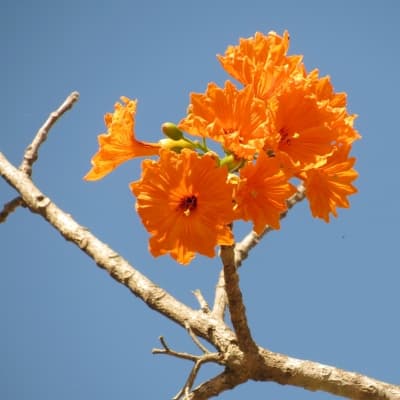
Cordia dodecandra
Cordia dodecandra
Safety & Hazards
None known
Cultivation Details
A plant of the lowland tropics, found at elevations up to 900 metres[1]. It grows in areas that have an average annual temperature of 26°c, with a maximum temperature of 36.7 °c and a minimum of 14.9 °c. Average annual precipitation is approximately 1,288mm, ranging from 900 - 1,800 mm[2]. Grows best in a sunny position in a fertile, well-drained soil[3]. Established plants are drought tolerant[3]. Plants are tolerant of salt-laden winds[3].
Propagation
Seed - very slow to germinate, the process can be sped up if the seed is scarified by lightly abrading the seedcoat to allow easier ingress of water[3]. Cuttings. Cite as: Tropical Plants Database, Ken Fern. tropical.theferns.info. 2026-02-20. <tropical.theferns.info/viewtropical.php?id=Cordia+dodecandra>
Pollinators
Data unavailable
References
- [1]Flora of Guatemala — Standley P.C. & J. A. Steyermark · 1946 - 1976 · http://www.archive.org/ ↩︎A superb reference, though somewhat dated. Gives lots of plant uses as well as information on plant habit and habitat. The entire flora (13 volumes) can now be downloaded from http://www.archive.org/
- [2]Timber Trees of Meso America. — UNEP · 2005 · http://www.unep-wcmc.org/forest/timber/workshops/reports/MA2005/Annex%202.pdf ↩︎A PDF document, published on the internet. Detailed reports on about 30 species of timber trees from Central America.
- [3]Tropical and Subtropical Trees - A Worldwide Encyclopaedic Guide. — Barwick. M. · Thames & Hudson, London · 2004 · ISBN 0-500-51181-0 ↩︎A superb book, very concise and well written, giving a wealth of information on 400 or more species including descriptions, habitat, cultivation details and plant uses. A wealth of colour photographs bring each plant vividly to life.
- [4]The New RHS Dictionary of Gardening. 1992. — Huxley. A. · MacMillan Press · 1992 · ISBN 0-333-47494-5 ↩︎Excellent and very comprehensive, though it contains a number of silly mistakes. Readable yet also very detailed.
- [5]Mansfeld's Database of Agricultural and Horticultural Plants — http://mansfeld.ipk-gatersleben.de/pls/htmldb_pgrc/f?p=185:3:4292127278597336 ↩︎Terse details of a huge range of useful plants.
- [6]Trees and Shrubs of Mexico — Standley P.C. · Smithsonian Institution; Washington · 1926 ↩︎Although dated, it contains a wealth of information on the trees and shrubs of Mexico, including many of their uses. It can be downloaded from the Internet.
- [7]Perennial Edible Fruits of the Tropics : an Inventory — Martin, F. W.; Campbell, C. W.; Rubertbe, R. M. · U.S. Dept. of Agriculture, Agricultural Research Service · 1987 ↩︎A booklet giving terse details of almost 300 species of edible fruits, plus regional lists of Botanical and Common names for over 2,500 less well-known edible fruits of the tropics.
- [8]Food Plants in the Americas: A Survey of the Domesticated, Cultivated, and Wild Plants Used for Human Food in North, — Kermath B.M.; Bennett B.C.' Pulsipher L.M. · 2014 ↩︎A pre-publication draft of an amazing, on-going work first started in 1985. It contains information on more than 3,900 taxa from the Americas - from Arctic regions to the Tropics
- [9]Flora of Yucatan — Standley P.C. · Field Museum of Natural History; Chicago · 1930 · http://www.biodiversitylibrary.org ↩︎The first flora that was attempted for this area in 1930, so it is obviously lacking information and the Botanical names can be out of date. Still, an excellent work and it records many plant uses. It can be downloaded from the Internet.
- [10]Dictionary of Economic Plants. — Uphof. J. C. Th. · Weinheim · 1959 · ISBN - ↩︎An excellent and very comprehensive guide but it only gives very short descriptions of the uses without any details of how to utilize the plants. Not for the casual reader.