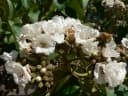
Cordia africana
Cordia africana
Safety & Hazards
None known
Cultivation Details
A plant of the drier to moist tropics, where it is found at elevations from 550 - 2,700 metres. It grows best in areas where annual daytime temperatures are within the range 25 - 30°c, but can tolerate 5 - 34°c[1]. Mature plants can be killed by temperatures of -2°c or lower, but young growth can be severely damaged at -1°c[1]. It prefers a mean annual rainfall in the range 700 - 1,500mm, but tolerates 500 - 2,000mm[1]. Prefers a sunny position[2]. Prefers light, deep, and well-drained soils and moist conditions, though it can succeed in most soils[2]. Prefers a pH in the range 5 - 6, tolerating 4.5 - 7[1]. A slow to moderately fast growing plant, it can reach a height of 7 - 8 metres after 7 years[2]. Plants can start flowering when 3 - 5 years old[3]. Plants coppice and pollard well[2].
Propagation
Seed - can be stored for up to 12 months[2]. Sow the seed in a nursery seedbed in full sun or light shade. A germination rate of about 65% can be expected, with the seeds starting to sprout after about 2 weeks, and most of them sprouting after 3 weeks. The young plants can be transplanted to their permanent positions about 4 - 6 months later[2]. Cite as: Tropical Plants Database, Ken Fern. tropical.theferns.info. 2026-02-20. <tropical.theferns.info/viewtropical.php?id=Cordia+africana>
Pollinators
Bees
References
- [1]Ecocrop — http://ecocrop.fao.org/ecocrop/srv/en/home ↩︎Basic information on a wide range of useful plants, plus details of environmental needs where available.
- [2]Indigenous multipurpose trees of Tanzania. — Hines. D.A. & Eckman. K. · 1993 · ISBN 0-9697075-0-9 ↩︎A simple handbook with information on over 50 species of trees found in Tanzania giving details of environmental requirements, cultivation needs, uses etc. It can be downloaded from the Internet.
- [3]World Agroforesty Centre — http://www.worldagroforestry.org/ ↩︎An excellent online database of a huge range of trees giving very good information on each plant - its uses, ecology, identity, propagation, pests etc.
- [4]The New RHS Dictionary of Gardening. 1992. — Huxley. A. · MacMillan Press · 1992 · ISBN 0-333-47494-5 ↩︎Excellent and very comprehensive, though it contains a number of silly mistakes. Readable yet also very detailed.
- [5]Protabase - Plant Resources of Tropical Africa. — http://www.prota.org ↩︎An excellent on-line database with detailed information on over 3,200 species of useful plants of Africa.
- [6]Mansfeld's Database of Agricultural and Horticultural Plants — http://mansfeld.ipk-gatersleben.de/pls/htmldb_pgrc/f?p=185:3:4292127278597336 ↩︎Terse details of a huge range of useful plants.
- [7]The Useful Plants of West Tropical Africa. — Burkil. H. M. · Royal Botanic Gardens; Kew. · 1985 - 2004 ↩︎Brief descriptions and details of the uses of over 4,000 plants. A superb, if terse, resource, it is also available electronically on the Web - see http://www.aluka.org/
- [8]IUCN Red List of Threatened Species — http://www.iucnredlist.org/ ↩︎A list of plants under threat and facing possible extinction, usually with brief details of the threats and information on habitat.