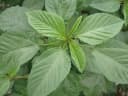
Corchorus olitorius
Corchorus olitorius
Safety & Hazards
None known
Cultivation Details
Corchorus olitorius grows well in the lowland tropics, up to an elevation of around 700 metres[1]. The plant is reported to tolerate a mean annual precipitation between 400 and 4290mm, an annual average temperature range of 16.8 to 27.5°c[2]. Prefers a very fertile, humus-rich, well-drained alluvial soil, though it is extremely tolerant of soil conditions[3, 1]. It grows best in a hot humid climate[3]. Tolerates very wet conditions according to one report[4] whilst another says that it does not tolerate waterlogged soils[3]. Some cultivars are sensitive to excess water in the soil, especially when they are young[1]. Tolerates a pH in the range of 4.5 to 8.2[2]. There are two important cultivar-groups:- Olitorius Group. These are the forms mainly grown for their edible leaves. They are characterized by a plant height lower than 2 metres, often not more than 1 metre, and a more or less heavily branched plant habit. There are many named forms within this group[5]. Textilis Group. These are the forms mainly grown for their fibre. The plants are usually larger, up to 4 metres, perhaps even 5 metres tall, and only slightly branched at the top[5]. The first harvest, by cutting shoots 20 - 30cm long, may take place 4 - 6 weeks after transplanting, at a height of 10 - 20cm above the ground. This cutting stimulates the development of side shoots. Subsequently, every 2 - 3 weeks, a cutting may take place, with a total of 2 - 8 cuttings possible[5]. For a once-over harvest from a direct sown crop, the plants are uprooted or cut at ground level when they are 30 - 40cm tall, 3 - 5 weeks after emergence and before the development of fruits[5]. In Nigeria, a yield of 20 - 25kg from a 10 square metre bed (25 tonnes per hectare) may be expected from 3 - 9 cuttings of 'Amugbadu' during a period of 3 - 4 months. A yield of 38 tonnes per hectare was obtained from a well-fertilized field of cultivar 'Ewondo' in the Cameroon. Farmers however, usually obtain average yields of 5 - 15 tonnes[5]. The world average jute yield is about 1.9 tonnes of raw fibre per hectare, but yields of 5 tonnes have been obtained in Bangladesh with improved cultivars grown under optimal agronomic conditions[5]. Intercropped with Vigna, jute has yielded 3,270 kilos compared to 2290 kilos when monocropped[2].
Propagation
Seed - sow spring in a greenhouse. When they are large enough to handle, prick the seedlings out into individual pots and plant them out in late spring, after the last expected frosts[6]. In areas with hot summers it should be possible to sow the seed in situ in mid spring. Cite as: Temperate Plants Database, Ken Fern. temperate.theferns.info. 2026-02-20. <temperate.theferns.info/plant/Corchorus+olitorius>
Pollinators
Self, Insects
References
- [1]Vegetables in the Tropics — Tindall. H. D. · MacMillan, Oxford. · 1983 · ISBN 0-333-24268-8 ↩︎An excellent, in-depth look at the main vegetable crops that can be grown in the Tropics, plus many less well-known plants.
- [2]Handbook of Energy Crops — Duke. J. · - · 1983 · https://hort.purdue.edu/newcrop/duke_energy/dukeindex.html · ISBN - ↩︎Published only on the Internet, excellent information on a wide range of both temperate and tropical plants.
- [3]A Weavers Garden — Buchanan. R. · McGraw-Hill Contemporary · 1987 · ISBN 0934026289 ↩︎Covers all aspects of growing your own clothes, from fibre plants to dyes.
- [4]Plants for Man. — Schery. R. W. ↩︎Fairly readable but not very comprehensive. Deals with plants from around the world.
- [5]Protabase - Plant Resources of Tropical Africa. — http://www.prota.org ↩︎An excellent on-line database with detailed information on over 3,200 species of useful plants of Africa.
- [6]The New RHS Dictionary of Gardening. 1992. — Huxley. A. · MacMillan Press · 1992 · ISBN 0-333-47494-5 ↩︎Excellent and very comprehensive, though it contains a number of silly mistakes. Readable yet also very detailed.
- [7]Cornucopia - A Source Book of Edible Plants. — Facciola. S. · Kampong Publications · 1990 · ISBN 0-9628087-0-9 ↩︎Excellent. Contains a very wide range of conventional and unconventional food plants (including tropical) and where they can be obtained (mainly N. American nurseries but also research institutes and a lot of other nurseries from around the world.
- [8]RHS Dictionary of Plants plus Supplement. 1956 — F. Chittendon. · Oxford University Press · 1951 · ISBN - ↩︎Comprehensive listing of species and how to grow them. Somewhat outdated, it has been replaced in 1992 by a new dictionary (see [ 200 ]).
- [9]The Vegetable Garden. — Vilmorin. A. · Ten Speed Press · ISBN 0-89815-041-8 ↩︎A reprint of a nineteenth century classic, giving details of vegetable varieties. Not really that informative though.
- [10]Dictionary of Economic Plants. — Uphof. J. C. Th. · Weinheim · 1959 · ISBN - ↩︎An excellent and very comprehensive guide but it only gives very short descriptions of the uses without any details of how to utilize the plants. Not for the casual reader.
- [11]A Dictionary of Plants Used by Man. — Usher. G. · Constable · 1974 · ISBN 0094579202 ↩︎Forget the sexist title, this is one of the best books on the subject. Lists a very extensive range of useful plants from around the world with very brief details of the uses. Not for the casual reader.
- [12]Sturtevant's Edible Plants of the World. — Hedrick. U. P. · Dover Publications · 1972 · ISBN 0-486-20459-6 ↩︎Lots of entries, quite a lot of information in most entries and references.
- [13]Edible Leaves of the Tropics — Martin. F. W.; Ruberte. R. M. & Meitzner. L. S. · Echo. USA. · 1998 · ISBN 0-9653360-1-8 ↩︎A terse guide, giving reasonable detail on the more common leaf crops and brief information on a wide range of lesser known plants.
- [14]Glossary of Indian Medicinal Plants (Including the Supplement). — Chopra. R. N., Nayar. S. L. and Chopra. I. C. · Council of Scientific and Industrial Research, New Delhi. · 1986 · ISBN - ↩︎Very terse details of medicinal uses of plants with a wide range of references and details of research into the plants chemistry. Not for the casual reader.
- [15]Economic Botany. — Hill. A. F. · The Maple Press · 1952 · ISBN - ↩︎Not very comprehensive, but it is quite readable and goes into some detail about the plants it does cover.
- [16]The Plant Wealth of Iraq. — Chakravarty. H. L. ↩︎It is surprising how many of these plants can be grown in Britain. A very readable book on the useful plants of Iraq.
- [17]Plant Fibres for Papermaking. — Bell. L. A. · Liliaceae Press · 1988 · ISBN - ↩︎A good practical section on how to make paper on a small scale plus details of about 75 species (quite a few of them tropical) that can be used.
- [18]Forest Flora of Chakrata, Dehra Dun and Saharanpur. — Gupta. B. L. · Forest Research Institute Press · 1945 · ISBN - ↩︎A good flora for the middle Himalayan forests, sparsly illustrated. Not really for the casual reader.