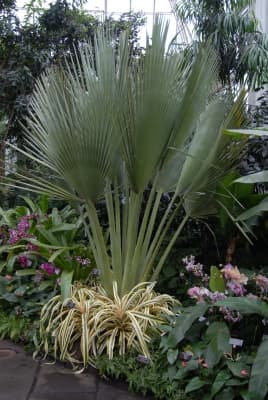
Arecaceae FAMILY Vulnerable
Copernicia gigas
Copernicia gigas
Edibility
0/5
Medicinal
0/5
Safety & Hazards
None known
Cultivation Details
HabitEvergreen Tree
Growth—
Plants can tolerate occasional light frosts with temperatures dropping to -2°c[1]. Prefers a position in light shade[1]. Prefers full sun[2]. Grows best in a moist soil[2]. Bats use the 'skirt' of dead, persistant leaves on the stem as a natural roosting site, and the concave petioles as nesting sites[3]. They deposit guano at the base of the palm, which helps to fertilize the tree[3].
Propagation
Seed - Cite as: Tropical Plants Database, Ken Fern. tropical.theferns.info. 2026-02-20. <tropical.theferns.info/viewtropical.php?id=Copernicia+gigas>
Pollinators
Data unavailable
References
- [1]Desert Tropicals — http://www.desert-tropicals.com/ ↩︎The main focus of the site is succulent plants, but it also contains information on a wide range of other species. Usually at least one good photograph, plus basic information about the plant and its cultivation.
- [2]Palm and Cycad Societies of Australia. — http://www.pacsoa.org.au/ ↩︎Contains at least a little information on the majority of palm and cycad species, plus a wealth of photographs. A first class website.
- [3]Field Guide to the Palms of the Americas — Henderson A.; Galeano G.; Bernal R. · Princeton University Press; Princeton, New Jersey. · 1995 · ISBN 0-691-08537-4 ↩︎An excellent book, giving basic information on all the 550 species of palms native to the Americas that were known in 1995. Comprehensive information on the plants range and habitat, brief description, some uses and almost 250 photos.
- [4]IUCN Red List of Threatened Species — http://www.iucnredlist.org/ ↩︎A list of plants under threat and facing possible extinction, usually with brief details of the threats and information on habitat.