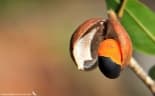
Copaifera langsdorffii
Copaifera langsdorffii
Cultivation Details
A plant of the moister tropics and subtropics, it requires a high humidity and a minimum temperature that does not fall much below 13°c[1]. It succeeds in areas where the mean annual rainfall can be within the range 1,000 - 4,000mm[2]. Prefers a sunny position[3]. Prefers a well-drained sandy soil and a position in shade[1]. Tolerates a pH in the range 4.5 - 7.5[2]. Established plants are drought tolerant[3], and also tolerate some waterlogging of the soil[2]. The tree is quite slow growing, two year old specimens are usually less than 2 metres tall[3]. The trees tend towards a triennial pattern of seed production[2]. A single copaiba tree can provide about 40 litres of oleoresin annually, making it a sustainable rainforest resource that can be harvested without destroying the tree or the forest in which it grows[4]. Trees can yield up to 55 litres of resin per year[1]. The resin accumulates in cavities within the tree trunk and is harvested by tapping or drilling holes into the wood of the trunk and collecting the resin that drips out, much in the same manner as harvesting maple syrup[4]. When tapped, the initial oily resin is clear, thin, and colourless; it thickens and darkens upon contact with air[4]. Commercially sold resins are a thick, clear liquid, with a colour that varies from pale yellow to golden light brown[4].
Propagation
Seed - best sown as soon as it is ripe in a semi-shaded position in a nursery seedbed or in individual containers[3]. A germination rate in excess of 60% can be expected, with the seeds sprouting within 20 - 40 days[3]. Seedlings grow away slowly[3]. Firm softwood cuttings[1]. Cite as: Tropical Plants Database, Ken Fern. tropical.theferns.info. 2026-02-20. <tropical.theferns.info/viewtropical.php?id=Copaifera+langsdorffii>
Pollinators
Bees
References
- [1]Encyclopaedia of Herbs and their Uses. — Bown. D. · Dorling Kindersley, London. · 1995 · ISBN 0-7513-020-31 ↩︎A very well presented and informative book on herbs from around the globe. Plenty in it for both the casual reader and the serious student. Just one main quibble is the silly way of having two separate entries for each plant.
- [2]World Agroforesty Centre — http://www.worldagroforestry.org/ ↩︎An excellent online database of a huge range of trees giving very good information on each plant - its uses, ecology, identity, propagation, pests etc.
- [3]Brazilian Trees. Volume 1. 4th Edition. — Lorenzi. H. · Instituto Plantarum De Estudos Da Flora; Brazil. · 2002 · ISBN 85-86714-17-8 ↩︎Information on 350 species of Brazilian trees. Stunning photographs of each species, brief details on the plant, its uses and how to grow it from seed. A superb work, with the minor irritation that the translation from Portuguese is not of the best.
- [4]Raintree Nutrition - Tropical Plant Database — http://www.rain-tree.com/plants.htm ↩︎Detailed information on the medicinal uses of more than two hundred rainforest plants, mainly from S. America, with basic descriptions of the plants, their other uses etc.
- [5]The Encyclopedia of Medicinal Plants — Chevallier. A. · Dorling Kindersley. London · 1996 · ISBN 9-780751-303148 ↩︎An excellent guide to over 500 of the more well known medicinal herbs from around the world.
- [6]Mansfeld's Database of Agricultural and Horticultural Plants — http://mansfeld.ipk-gatersleben.de/pls/htmldb_pgrc/f?p=185:3:4292127278597336 ↩︎Terse details of a huge range of useful plants.
- [7]IUCN Red List of Threatened Species — http://www.iucnredlist.org/ ↩︎A list of plants under threat and facing possible extinction, usually with brief details of the threats and information on habitat.
- [8]Dictionary of Economic Plants. — Uphof. J. C. Th. · Weinheim · 1959 · ISBN - ↩︎An excellent and very comprehensive guide but it only gives very short descriptions of the uses without any details of how to utilize the plants. Not for the casual reader.
- [9]Tropix 7 — CIRAD · http://tropix.cirad.fr/en ↩︎An on-line guide to the timbers of 245 species of trees.