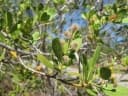
Conocarpus erectus
Conocarpus erectus
Safety & Hazards
None known
Cultivation Details
A plant of the moist, lowland tropics, where it is found at elevations up to 200 metres. It grows best in areas where annual daytime temperatures are within the range 20 - 30°c, but can tolerate 10 - 38°c[1]. It prefers a mean annual rainfall in the range 1,500 - 2,500mm, but tolerates 1,000 - 3,000mm[1]. Requires a position in full sun[2]. A very amenable plant, able to thrive on dry soils away from the mangroves; marl-filled land with a high brackish water table; and poor, sandy soils[2]. Established plants are very drought tolerant[2]. Prefers a pH in the range 5 - 7, tolerating 5 - 7.5[1]. The plant can form extensive thickets by sprawling and rooting where the stems touch the ground[2]. There are two distinct forms of this tree, both of which can be found growing side by side in the wild. The species has green leaves, whilst var sericeus (known as silver buttonwood) has silvery leaves[2]. The fruits float in water, thus allowing the seeds to be dispersed more widely[2].
Propagation
Seed - best sown as soon as it is ripe in a sunny position in a nursery seedbed[3]. Cuttings. Even large branches can root, especially if planted in wet soil[2]. Layering. Cite as: Tropical Plants Database, Ken Fern. tropical.theferns.info. 2026-02-20. <tropical.theferns.info/viewtropical.php?id=Conocarpus+erectus>
Pollinators
Data unavailable
References
- [1]Ecocrop — http://ecocrop.fao.org/ecocrop/srv/en/home ↩︎Basic information on a wide range of useful plants, plus details of environmental needs where available.
- [2]Tropical and Subtropical Trees - A Worldwide Encyclopaedic Guide. — Barwick. M. · Thames & Hudson, London · 2004 · ISBN 0-500-51181-0 ↩︎A superb book, very concise and well written, giving a wealth of information on 400 or more species including descriptions, habitat, cultivation details and plant uses. A wealth of colour photographs bring each plant vividly to life.
- [3]Brazilian Trees. Volume 3. — Lorenzi. H. · Instituto Plantarum De Estudos Da Flora; Brazil. · 2009 · ISBN 85-86714-34-4 ↩︎Information on 350 species of Brazilian trees. Stunning photographs of each species, brief details on the plant, its uses and how to grow it from seed. A superb work, with the minor irritation that the translation from Portuguese is not of the best.
- [4]IUCN Red List of Threatened Species — http://www.iucnredlist.org/ ↩︎A list of plants under threat and facing possible extinction, usually with brief details of the threats and information on habitat.
- [5]Dictionary of Economic Plants. — Uphof. J. C. Th. · Weinheim · 1959 · ISBN - ↩︎An excellent and very comprehensive guide but it only gives very short descriptions of the uses without any details of how to utilize the plants. Not for the casual reader.
- [6]A Century of Trees of Panama. — Pittier H. Mell C.D. · http://www.biodiversitylibrary.org ↩︎A work that was very difficult to get published according to the correspondence contained at the start!. A treatment of 100 different species with descriptions and details of uses. It can be downloaded from the Internet.
- [7]Flora Zambesiaca — http://apps.kew.org/efloras/fz/intro.html ↩︎An excellent online flora of plants from the Zambezi River basin. It lists a number of the plant uses as well as the habitats and botanical descriptions of the plants.
- [PFAF]Plants for a Future — pfaf.org ↩︎