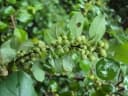
Commiphora wightii
Commiphora wightii
Safety & Hazards
None known
Cultivation Details
A plant of arid and semi-arid areas in the tropics where it can be found at elevations from 250 - 1,800 metres. It is found in areas where the mean annual rainfall is within the range 225 - 500mm and the temperature ranges from 20 - 35°c[1]. Requires a sunny position[1]. Found in the wild in sandy and rocky soils[1]. A slow growing plant, it takes 8 to 10 years to reach a height of 3 - 3.5 metres. Pruning or the removal of branches in the early stages of the plant's growth helps to achieve better growth, increases the girth of growing branches and thereby leads to better gum yield[1]. The plant generally takes ten years to reach tapping maturity under the dry climatic conditions of its native environment[1]. The yields are in the order of 200 - 500 gm of dry guggul per tree per season[1]. Plants are dimorphic, one form having bisexual and male flowers, whilst the other has female flowers with staminodes[2]. It is inferred that pollen grains from bisexual or male flowers, present on the first form of plants are needed for the production of normal fruits on plants with only female flowers[2].
Propagation
Seed - Cite as: Tropical Plants Database, Ken Fern. tropical.theferns.info. 2026-02-20. <tropical.theferns.info/viewtropical.php?id=Commiphora+wightii>
Pollinators
Data unavailable
References
- [1]World Agroforesty Centre — http://www.worldagroforestry.org/ ↩︎An excellent online database of a huge range of trees giving very good information on each plant - its uses, ecology, identity, propagation, pests etc.
- [2]Flora of Pakistan — http://www.efloras.org ↩︎As of 2006, there is not much information on habitats available, but it is being developed and promises to be an excellent resource.
- [3]IUCN Red List of Threatened Species — http://www.iucnredlist.org/ ↩︎A list of plants under threat and facing possible extinction, usually with brief details of the threats and information on habitat.
- [4]Cornucopia II — Facciola. S. · Kampong Publications, California. · 1998 · ISBN 0-9628087-2-5 ↩︎The second edition of an excellent guide to the edible uses of plants, though it does not give any details of cultivation etc.
- [5]Dictionary of Economic Plants. — Uphof. J. C. Th. · Weinheim · 1959 · ISBN - ↩︎An excellent and very comprehensive guide but it only gives very short descriptions of the uses without any details of how to utilize the plants. Not for the casual reader.
- [6]Glossary of Indian Medicinal Plants (Including the Supplement). — Chopra. R. N., Nayar. S. L. and Chopra. I. C. · Council of Scientific and Industrial Research, New Delhi. · 1986 · ISBN - ↩︎Very terse details of medicinal uses of plants with a wide range of references and details of research into the plants chemistry. Not for the casual reader.
- [7]Protabase - Plant Resources of Tropical Africa. — http://www.prota.org ↩︎An excellent on-line database with detailed information on over 3,200 species of useful plants of Africa.