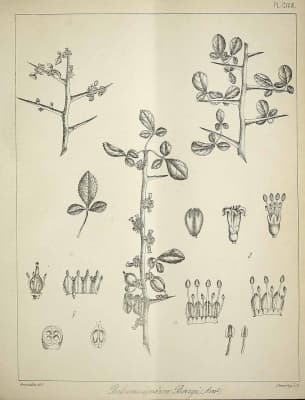
Burseraceae FAMILY
Commiphora berryi
Commiphora berryi
Edibility
0/5
Medicinal
2/5
Safety & Hazards
None known
Cultivation Details
HabitDeciduous Tree
Growth—
A plant of the semi-arid tropics, though it has been shown to grow in much moister climates[1]. Requires a sunny position and a well drained soil. When grown in the moister tropics, the spines almost disappear, the leaflets become much larger, and the inflorescence more developed, the whole plant thus putting on a very different look[1]. Closely allied to the species that yield Myrrh [C. Myrrha), and Balm of Gilead, (C. Gileadensis)[1]
Propagation
Seed - Cite as: Tropical Plants Database, Ken Fern. tropical.theferns.info. 2026-02-20. <tropical.theferns.info/viewtropical.php?id=Commiphora+berryi>
Pollinators
Data unavailable
References
- [1]A Handbook to the Flora of Ceylon — Trimen H.; continued by Hooker J.D. · Dulau and Co; London. · 1898 · http://www.biodiversitylibrary.org ↩︎Very dated, but still a useful work. It can be downloaded from the Internet.
- [2]Pharmacognostical standardization of Commiphora berryi and phytochemical studies on its crude extracts — Selvamani P.; Sen D.J.; Gupta J.K. · African Journal of Pharmacy and Pharmacology · 2009 · ISBN 1996-0816 ↩︎A microscopic study of the physical structure of Commiphora berryi.
- [3]Mansfeld's Database of Agricultural and Horticultural Plants — http://mansfeld.ipk-gatersleben.de/pls/htmldb_pgrc/f?p=185:3:4292127278597336 ↩︎Terse details of a huge range of useful plants.
- [4]Dictionary of Economic Plants. — Uphof. J. C. Th. · Weinheim · 1959 · ISBN - ↩︎An excellent and very comprehensive guide but it only gives very short descriptions of the uses without any details of how to utilize the plants. Not for the casual reader.