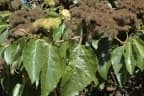
Commersonia bartramia
Commersonia bartramia
Safety & Hazards
None known
Cultivation Details
Commersonia bartramia is a plant of the subtropics to the tropics, where it can be found at elevations up to 800 metres[1]. Trees are rather frost-sensitive[1]. Often found in the wild in both in brown clay-loams or white sand soils[2]. A fast-growing tree[1]. Plants can flower all year round in some parts of its range[2].
Propagation
Seed - tiny and long-lived. Best sown as soon as it is ripe, it can be germinated by blending the whole capsules, then covering the mix with almost boiling water (making sure it cools down quickly enough not to cook and kill the seed) and then sowing the resulting fibrous mass[1]. Cuttings strike quickly and easily[1]. Cite as: Tropical Plants Database, Ken Fern. tropical.theferns.info. 2026-02-20. <tropical.theferns.info/viewtropical.php?id=Commersonia+bartramia>
Pollinators
Data unavailable
References
- [1]Australian Rainforest Plants Volumes 1 - 6 — Nicholson N. & H. · Terania Rainforest Publishing; New South Wales. · 2007 · ISBN 9-78095894-3628 ↩︎Beautiful set of booklets with a terse description of over 600 species and their habitat, often including some of their uses and notes on their cultivation, plus at least one, excellent photograph.
- [2]A revision of Commersonia including Rulingia (Malvaceae s.l. or Byttneriaceae) — Wilkins C.F. & Whitlock B.A. · 2011 · http://dx.doi.org/10.1071/SB10031_CO ↩︎
- [3]Agroforestry in the Pacific Islands: Systems for Sustainability — W.C. Clarke and R.R. Thaman (Editors) · United Nations University Press, Tokyo · 1993 · http://www.unu.edu/unupress/unupbooks/80824e/80824E00.htm#Contents · ISBN 92-808-0824-9 ↩︎The guide includes information on 100 species of plants for Agroforestry. It is also available on the web at the address given above.
- [4]Annals of the Missouri Botanical Gardens Vol. 46 — Missouro Botanical Garden · 1959 ↩︎An excellent botanical publication, available for download from the Internet. Amongst other things, this issue contains a review of the genus Daphnopsis.
- [5]The Useful Native Plants of Australia. — Maiden J.H. · Turner & Co.; London. · 1889 · http://www.biodiversitylibrary.org ↩︎Terse details of the uses of many Australian plants and other species naturalised, or at least growing, in Australia. It can be downloaded from the Internet.
- [6]Plants of Southeast Asia — http://www.asianplant.net/ ↩︎Excellent site with brief information on the plant, its range, habitat and uses, plus phots of specimens, close-ops of flowers and leaves etc,