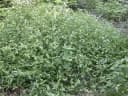
Commelina erecta
Commelina erecta
Safety & Hazards
None known
Cultivation Details
Commelina erecta can succeed in a wide range of climatic conditions, with its range extending from tropical America to the temperate regions of eastern USA[1]. The plant is not very winter hardy, however, and in temperate regions the roots are best dug up in the autumn and stored like dahlia tuberss in a cool frost free place and then planted out in spring[2]. When grown in a light well-drained soil and mulched well, the roots will usually survive the winter outdoors in the milder regions of the temperate zone[3]. Prefers a light well-drained loam with added leafmold[3, 4]. Succeeds in an ordinary, reasonably moist soil in a sunny position with some shelter[5]. A polymorphic plant[2].
Propagation
Seed - sow early spring in a greenhouse. The seed usually germinates in 4 - 5 weeks at 20°c[5]. When they are large enough to handle, prick the seedlings out into individual pots plant them out in late spring or early summer, after the last expected frosts. Division in early spring. Make sure that each portion has at least one growing bud[6, PFAF]. Cuttings during the growing season. Very easy[2]. Cite as: Temperate Plants Database, Ken Fern. temperate.theferns.info. 2026-02-20. <temperate.theferns.info/plant/Commelina+erecta>
Pollinators
Data unavailable
References
- [1]Flora of Guatemala — Standley P.C. & J. A. Steyermark · 1946 - 1976 · http://www.archive.org/ ↩︎A superb reference, though somewhat dated. Gives lots of plant uses as well as information on plant habit and habitat. The entire flora (13 volumes) can now be downloaded from http://www.archive.org/
- [2]The New RHS Dictionary of Gardening. 1992. — Huxley. A. · MacMillan Press · 1992 · ISBN 0-333-47494-5 ↩︎Excellent and very comprehensive, though it contains a number of silly mistakes. Readable yet also very detailed.
- [3]RHS Dictionary of Plants plus Supplement. 1956 — F. Chittendon. · Oxford University Press · 1951 · ISBN - ↩︎Comprehensive listing of species and how to grow them. Somewhat outdated, it has been replaced in 1992 by a new dictionary (see [ 200 ]).
- [4]Hardy Bulbs.; Including Half-hardy Bulbs and Tuberous and Fiberous-rooted Plants — Grey. C. H. · Williams & Norgate. · 1938 · ISBN - ↩︎Rather dated now, but an immense work on bulbs for temperate zones and how to grow them. Three large volumes.
- [5]Growing from Seed. Volume 4. — Bird. R. (Editor) · Thompson and Morgan. · 1990 · ISBN - ↩︎Very readable magazine with lots of information on propagation. A good article on Yuccas, one on Sagebrush (Artemesia spp) and another on Chaerophyllum bulbosum.
- [6]Popular Hardy Perennials. — Sanders. T. W. · Collingridge · 1926 · ISBN - ↩︎A fairly wide range of perennial plants that can be grown in Britain and how to grow them.
- [7]Tanaka's Cyclopedia of Edible Plants of the World. — Tanaka. T. & Nakao S. · Keigaku Publishing; Tokyo · 1976 · ISBN - ↩︎The most comprehensive list of edible plants I've come across. Only the briefest entry for each species, though, and some of the entries are more than a little dubious. Not for the casual reader.
- [8]Gray's Manual of Botany.Eighth Edition — Fernald. M. L. · American Book Co.; New York · 1950 · ISBN 0442222505 ↩︎A bit dated but a good and concise flora of the eastern part of N. America.
- [9]Sturtevant's Edible Plants of the World. — Hedrick. U. P. · Dover Publications · 1972 · ISBN 0-486-20459-6 ↩︎Lots of entries, quite a lot of information in most entries and references.
- [10]Plants for Human Consumption. — Kunkel. G. · Koeltz Scientific Books · 1984 · ISBN 3874292169 ↩︎An excellent book for the dedicated. A comprehensive listing of Latin names with a brief list of edible parts.
- [11]Medicinal Plants of the Guianas — DeFilipps, R. A.; Maina, S. L.; & Crepin, J. · Smithsonian Museum · http://botany.si.edu/bdg/medicinal/index.html ↩︎A down-loadable PDF document of a book in pre-publication awaiting illustration. An excellent, if rather terse, guide to the traditional medicinal uses of the plants of the region
- [PFAF]Plants for a Future — pfaf.org ↩︎