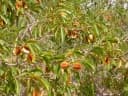
Combretum micranthum
Combretum micranthum
Safety & Hazards
None known
Cultivation Details
A plant of the drier tropics, where it is found at elevations up to 1,000 metres. It grows best in areas where annual daytime temperatures are within the range 22 - 35°c, but can tolerate 10 - 45°c[1]. Mature plants can be killed by temperatures of -5°c or lower, but new growth can be severely damaged at -1°c[1]. It prefers a mean annual rainfall in the range 500 - 1,300mm, but tolerates 300 - 1,500mm[1]. Requires a sunny position[1]. Succeeds on sandstone, clay, laterite, crystalline rocks, and skeletal soils[2]. Grows well on dry soils and is very drought tolerant once established[2]. Its presence in natural habitats is often an indicator of poor, low nutrient soils[2]. Prefers a pH in the range 6 - 7, tolerating 5.5 - 7.5[1]. Plants can recover from damage by forest fires[1].
Propagation
Seed - pre-soaking for 24 hours in water increases the rate of germination. Removing the covering structures from the seed can also improve the level of germination. Germination rates are usually high, up to 100%[2]. The seed can be stored long-term. More than 96% germination rate was achieved from dried seeds 4 years old that had been stored at 4°C[2]. Cite as: Tropical Plants Database, Ken Fern. tropical.theferns.info. 2026-02-20. <tropical.theferns.info/viewtropical.php?id=Combretum+micranthum>
Pollinators
Data unavailable
References
- [1]Ecocrop — http://ecocrop.fao.org/ecocrop/srv/en/home ↩︎Basic information on a wide range of useful plants, plus details of environmental needs where available.
- [2]Seed Leaflets — Various · Forest & Landscape. Denmark · http://en.sl.life.ku.dk/Publikationer/Udgivelser/PopulaerPublikationer.aspx?katid={D28373CC-6EF3-4EF8-B097-6D83FABF209E}&serieid={9F1C3DB1-6E7B-4CF1-AF53-F480B0CB40EF}&sort=title ↩︎A series of leaflets, jointly produced by the University of Copenhagen and the Royal Botanic Gardens at Kew, focussing on seed information for a number species, but also giving a lot of other information about each plant.
- [3]Dictionary of Economic Plants. — Uphof. J. C. Th. · Weinheim · 1959 · ISBN - ↩︎An excellent and very comprehensive guide but it only gives very short descriptions of the uses without any details of how to utilize the plants. Not for the casual reader.
- [4]Trees and Shrubs of the Sahel. Their Characteristics and Uses. — von Maydell H. · Deutsche Gesellschaft fur Technische Zusammenarbeit; Germany · 1990 · ISBN 3-8236-1198-4 ↩︎A well-researched book, usually with more than one photograph of each species and good information on the plant and its uses.