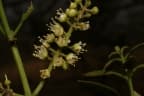
Combretum glutinosum
Combretum glutinosum
Safety & Hazards
None known
Cultivation Details
A plant of the arid to semi-arid tropics, succeeding in areas where the annual mean rainfall is in the range 200 - 900mm[1]. Thrives best on sandy and other free-draining soils[2]. Established plants are very drought tolerant[2]. Plants are particularly resistant to arid conditions, surviving where grasses will not, and recovering quickly from burning[1]. Flowering is in the dry season after bush fires to which it is very resistant[1]. Once established in an area, it easily forms dense stands[1]. The tree coppices well[1]. Plants are often infected by Loranthaceae plant parasites[1].
Propagation
Seed - removing the covering structures from the seeds improves the rate of germination[2]. Extraction is done manually by pulling apart opposite wings[2]. The optimum temperature for germination is between 25 and 30C, where 100% of seeds germinate[2]. Germination rates of 70% or more are achieved at temperatures between 15 to 35C[2]. The seed stores well. Germination rates up to 86% have been achieved after 18 month storage in a cool room at 4C[2]. Cite as: Tropical Plants Database, Ken Fern. tropical.theferns.info. 2026-02-20. <tropical.theferns.info/viewtropical.php?id=Combretum+glutinosum>
Pollinators
Data unavailable
References
- [1]Protabase - Plant Resources of Tropical Africa. — http://www.prota.org ↩︎An excellent on-line database with detailed information on over 3,200 species of useful plants of Africa.
- [2]Seed Leaflets — Various · Forest & Landscape. Denmark · http://en.sl.life.ku.dk/Publikationer/Udgivelser/PopulaerPublikationer.aspx?katid={D28373CC-6EF3-4EF8-B097-6D83FABF209E}&serieid={9F1C3DB1-6E7B-4CF1-AF53-F480B0CB40EF}&sort=title ↩︎A series of leaflets, jointly produced by the University of Copenhagen and the Royal Botanic Gardens at Kew, focussing on seed information for a number species, but also giving a lot of other information about each plant.
- [3]Trees and Shrubs of the Sahel. Their Characteristics and Uses. — von Maydell H. · Deutsche Gesellschaft fur Technische Zusammenarbeit; Germany · 1990 · ISBN 3-8236-1198-4 ↩︎A well-researched book, usually with more than one photograph of each species and good information on the plant and its uses.