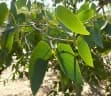
Colophospermum mopane
Colophospermum mopane
Safety & Hazards
None known
Cultivation Details
A plant of the drier, lowland tropics, where it is found at elevations up to 1,200 metres, growing best below 900 metres[1]. It grows best in areas where annual daytime temperatures are within the range 26 - 36°c, but can tolerate 12 - 50°c[1]. It can be killed by temperatures of -1°c or lower[1]. The plant only withstands mild frosts - heavy frosts may cause the branches to die back[1]. It prefers a mean annual rainfall in the range 250 - 500mm, but tolerates 150 - 900mm[1]. Grows best in a sunny position, tolerating light shade[1]. Flourishes in sandy soils and low-lying alluvium floodplains, but succeeds in most soils of moderate to low fertility[1, 2]. It prefers a well-drained soil, though can tolerate some water-logging[1]. Established plants are very drought tolerant[1]. Prefers a pH in the range 5.5 - 7.5, tolerating 5 - 8.5[1]. Trees can commence flowering when they are 5 years old[3]. The sticky seeds cling to the hooves of passing animals and are dispersed. They are also wind dispersed[3]. The leaves and fruits are very glandular and smell strongly of turpentine[4]. The tree coppices vigorously after fire, frost or felling[1]. Trees of this species are often hit by lightening during thunderstorms, and are considered to be a dangerous place to take refuge[2]. The tree is host to a small, non-stinging but very irritating bee (Melipona species) that is attacted to the moisture of a victim's eyes and nose - attacks are most annoying around midday and repellents afford little relief[2]. This species has a symbiotic relationship with certain soil bacteria, these bacteria form nodules on the roots and fix atmospheric nitrogen. Some of this nitrogen is utilized by the growing plant but some can also be used by other plants growing nearby[5].
Propagation
Seed - retains its viability for at least 3 years[3]. The seed pods do not split open of their own accord and the seeds can germinate while still in the pod[6]. Removing the seed from the pod does speed up germination but needs to be done carefully. They should be sown in flat seedling trays in river sand. Place the seeds on the sand surface. Keep the trays moist so that the seed can absorb water to germinate[6]. The seedlings are initially slow growing but the growth rate speeds up once a height of about 20cm is reached. Transplanting will need to be done with care, try to avoid damaging the roots[6]. Cite as: Tropical Plants Database, Ken Fern. tropical.theferns.info. 2026-02-20. <tropical.theferns.info/viewtropical.php?id=Colophospermum+mopane>
Pollinators
Data unavailable
References
- [1]Ecocrop — http://ecocrop.fao.org/ecocrop/srv/en/home ↩︎Basic information on a wide range of useful plants, plus details of environmental needs where available.
- [2]The Leguminosae; A Source Book of Characteristics, Uses and Nodulation — Allen O.N.; Allen E.K. · University of Wisconsin · 1981 · ISBN 0-333-32221-5 ↩︎An amazing and comprehensive work, giving a brief guide to the many genera of the family Fabaceae and also the principle uses of the genus.
- [3]World Agroforesty Centre — http://www.worldagroforestry.org/ ↩︎An excellent online database of a huge range of trees giving very good information on each plant - its uses, ecology, identity, propagation, pests etc.
- [4]Flora Zambesiaca — http://apps.kew.org/efloras/fz/intro.html ↩︎An excellent online flora of plants from the Zambezi River basin. It lists a number of the plant uses as well as the habitats and botanical descriptions of the plants.
- [5]The New RHS Dictionary of Gardening. 1992. — Huxley. A. · MacMillan Press · 1992 · ISBN 0-333-47494-5 ↩︎Excellent and very comprehensive, though it contains a number of silly mistakes. Readable yet also very detailed.
- [6]PlantZAfrica.com — http://www.plantzafrica.com ↩︎An excellent site giving detailed descriptions and uses of many S. African plants.
- [7]African Flowering Plants Database — Conservatoire et Jardin Botaniques. · http://www.ville-ge.ch/musinfo/bd/cjb/africa/recherche.php ↩︎Contains information on over 150,000 plant names (including synonyms) giving a description and habitat, plus a distribution map.
- [8]Flora and Fauna of Africa — http://www.gateway-africa.com/fuanaflora/index.html ↩︎Contains photos and basic information on the plant and its uses. So far just over 70 species appear on the site, though they say that it is a work in progress.
- [9]Dictionary of Economic Plants. — Uphof. J. C. Th. · Weinheim · 1959 · ISBN - ↩︎An excellent and very comprehensive guide but it only gives very short descriptions of the uses without any details of how to utilize the plants. Not for the casual reader.
- [PFAF]Plants for a Future — pfaf.org ↩︎