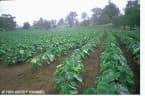
Colocasia esculenta
Colocasia esculenta
Safety & Hazards
The plant contains calcium oxalate crystals. These cause an extremely unpleasant sensation similar to needles being stuck into the mouth and tongue if they are eaten, but they are easily neutralized by thoroughly drying or cooking the plant or by steeping it in water.
Cultivation Details
Taro is a plant of the moist to humid tropics, where it can be grown at elevations up to 2,700 metres. It grows best in areas where annual daytime temperatures are within the range 21 - 28°c, but can tolerate 10 - 35°c[1]. It prefers a mean annual rainfall in the range 1,800 - 2,700mm, but tolerates 1,000 - 4,100mm[1]. Grows best in a sunny position, tolerating light shade[1]. Prefers a fairly heavy, fertile and moisture-retentive soil that is rich in organic matter[2]. Plants require a very fertile soil[3]. Some cultivars are tolerant of high soil salinity[4]. Needs a moist soil in order to grow well - some varieties will even grow in shallow water[5]. Taro is often cultivated in paddy-type fields where it is grown in standing water for part of the time[3]. Prefers a pH in the range 5.5 - 6.5, tolerating 4.3 - 8.2[1]. The plant can take from 6 - 18 months to produce a harvest of corms, though 7 - 10 months is the average[1]. The leaves and stems can be harvested throughout the growing period[3]. Yields of up to 37 tonnes/ha have been obtained in Hawaii under flooded conditions, while 25 tonnes/ha have been reported under dry-land cultivation[1]. Average yields may range from 4 - 6 tonnes/ha[1]. There are many named varieties[5]. Like many species in the family Araceae, this plant has the ability to heat the flowering spadix as the pollen becomes ready for fertilization. This heat greatly increases the strength of the aroma released by the plant, thus attracting more pollinating insects. It can also have the effect of making the insects more active, thus increasing the level of fertilization[6].
Propagation
Seed - this is a cultivated species and so seed is unlikely to breed true. Plants rarely produce fertile seed[7]. Division of suckers[5]. Corms. Usually the small, unmarketable corms, 60 - 150g in weight, obtained from healthy, productive plants are used[4]. Larger corms can be divided into pieces and used[4]. The apical 1 - 2cm of the main corm, with 15 - 20cm of the leaf stalks attached[4]. Side suckers, growing from the main corm. In Ghana planting is mainly by use of either young suckers or mature setts cut from harvested corms. Planting material must be taken from healthy plants. Cormels are planted at a depth of 50 - 75mm[4]. Cite as: Tropical Plants Database, Ken Fern. tropical.theferns.info. 2026-02-20. <tropical.theferns.info/viewtropical.php?id=Colocasia+esculenta>
Pollinators
Insects
References
- [1]Ecocrop — http://ecocrop.fao.org/ecocrop/srv/en/home ↩︎Basic information on a wide range of useful plants, plus details of environmental needs where available.
- [2]The New RHS Dictionary of Gardening. 1992. — Huxley. A. · MacMillan Press · 1992 · ISBN 0-333-47494-5 ↩︎Excellent and very comprehensive, though it contains a number of silly mistakes. Readable yet also very detailed.
- [3]Edible Leaves of the Tropics — Martin. F. W.; Ruberte. R. M. & Meitzner. L. S. · Echo. USA. · 1998 · ISBN 0-9653360-1-8 ↩︎A terse guide, giving reasonable detail on the more common leaf crops and brief information on a wide range of lesser known plants.
- [4]Protabase - Plant Resources of Tropical Africa. — http://www.prota.org ↩︎An excellent on-line database with detailed information on over 3,200 species of useful plants of Africa.
- [5]Tropical Food Gardens — Norrington. L. · Bloomings Books (Melbourne) · 2001 · ISBN 1-876473-41-x ↩︎Excellent little book giving some basic information on a range of plants.
- [6]Aroids: Plants of the Arum Family. — Bown D. · Timber Press; Portland, Oregon. · 2000 · ISBN 0-88192-485-7 ↩︎An excellent treatment of the family Araceae, giving lots of information about the plants, how to grow them, their uses etc. I found it a bit disordered - if you want all the information on a specific species you have to trawl through the whole book.
- [7]Vegetables in the Tropics — Tindall. H. D. · MacMillan, Oxford. · 1983 · ISBN 0-333-24268-8 ↩︎An excellent, in-depth look at the main vegetable crops that can be grown in the Tropics, plus many less well-known plants.
- [8]Medicinal Plants in the South Pacific — WHO Regional Publications, Manilla. · 1998 · ISBN 92-9061-118-9 ↩︎Excellent guide to 102 medicinal herbs of the Pacific Islands, with photographs of each plant and details of their constituents, biological activities and traditional uses. A description of each plant, together with habitat and distribution is given.
- [PFAF]Plants for a Future — pfaf.org ↩︎