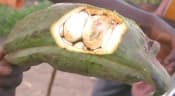
Cola acuminata
Cola acuminata
Safety & Hazards
None known
Cultivation Details
Cola needs a hot humid climate, with a mean annual temperature in the range 26 - 35°c, and a mean annual rainfall of 1,200 - 1,800mm[1]. However, it can withstand a dry season on sites with a high ground water level and it may be cultivated in drier areas where ground water is available[1]. Though it is a lowland forest tree it has also been found at altitudes over 300 metres on deep rich soils under heavy and evenly distributed rainfall[1]. Prefers a minimum temperature no lower than 13°c[2]. Prefers a deep, rich, well-drained soil[1, 3], although it may also be found in marshy areas[1]. Does well in both light and heavy soils[1]. Intolerant of soils with a high pH[4]. Cola grows naturally in the shade, but it develops a better spreading crown which yields more fruits when grown in open places[1]. Trees start producing at around the age of 12 - 15 years and can produce 10 - 16 kilos of seed annually for more than 80 years[2]. Trees commence flowering and fruiting when they are small[3]. Yields of 300 nuts per mature tree are considered good[1]. Plants are often used as shade trees for cocoa (Theobroma cacao) plantations[2]. Muslims consider the cola nut as sacred and brought by the prophet Mohammed. They use the nut for ceremonial and social occasions[1].
Propagation
Seed - sow individually in containers[5]. The seedlings are sometimes raised in pots or in polythene bags before planting out[1]. Ripe fruits harvested before the follicles split open, the seeds or nuts are extracted from the follicles and the white aril removed after 5 days of fermentation. Nuts for planting are the mature ones that have undergone after-ripening[1]. Cuttings of mature wood[5]. Aerial layering. Cite as: Tropical Plants Database, Ken Fern. tropical.theferns.info. 2026-02-20. <tropical.theferns.info/viewtropical.php?id=Cola+acuminata>
Pollinators
Data unavailable
References
- [1]World Agroforesty Centre — http://www.worldagroforestry.org/ ↩︎An excellent online database of a huge range of trees giving very good information on each plant - its uses, ecology, identity, propagation, pests etc.
- [2]Encyclopaedia of Herbs and their Uses. — Bown. D. · Dorling Kindersley, London. · 1995 · ISBN 0-7513-020-31 ↩︎A very well presented and informative book on herbs from around the globe. Plenty in it for both the casual reader and the serious student. Just one main quibble is the silly way of having two separate entries for each plant.
- [3]Tropical and Subtropical Trees - A Worldwide Encyclopaedic Guide. — Barwick. M. · Thames & Hudson, London · 2004 · ISBN 0-500-51181-0 ↩︎A superb book, very concise and well written, giving a wealth of information on 400 or more species including descriptions, habitat, cultivation details and plant uses. A wealth of colour photographs bring each plant vividly to life.
- [4]Perennial Edible Fruits of the Tropics : an Inventory — Martin, F. W.; Campbell, C. W.; Rubertbe, R. M. · U.S. Dept. of Agriculture, Agricultural Research Service · 1987 ↩︎A booklet giving terse details of almost 300 species of edible fruits, plus regional lists of Botanical and Common names for over 2,500 less well-known edible fruits of the tropics.
- [5]The New RHS Dictionary of Gardening. 1992. — Huxley. A. · MacMillan Press · 1992 · ISBN 0-333-47494-5 ↩︎Excellent and very comprehensive, though it contains a number of silly mistakes. Readable yet also very detailed.
- [6]Cornucopia II — Facciola. S. · Kampong Publications, California. · 1998 · ISBN 0-9628087-2-5 ↩︎The second edition of an excellent guide to the edible uses of plants, though it does not give any details of cultivation etc.
- [7]The Encyclopedia of Medicinal Plants — Chevallier. A. · Dorling Kindersley. London · 1996 · ISBN 9-780751-303148 ↩︎An excellent guide to over 500 of the more well known medicinal herbs from around the world.