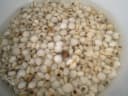
Coix lacryma-jobi
Coix lacryma-jobi
Safety & Hazards
None known
Cultivation Details
Coix lacryma-job grows best in the moister areas of the tropics, succeeding at elevations up to 2,000 metres[1]. It is reported to tolerate an annual precipitation in the range of 610 - 4290mm and an average annual temperature range from 9.6 to 27.8°c[2]. Plants are not very tolerant of frost[3], though one report that needs veryfying says that some forms of the plant are said to be very cold tolerant, with reports of plants surviving occasional lows to -35°c[4]. Grows best in a sunny position[5, 6]. Succeeds in ordinary garden soil, but best results are obtained when grown in reasonably fertile conditions[6, 1]. Prefers a little shelter from the wind. Grows best in a pH within the range 4.5 - 8.4[2]. In a suitable climate, it takes about 4 - 5 months from seed to produce new seed[2]. Usually, whole plants are cut at the base when the grain is ripe. The stubble can be left in the field and will then regrow[1]. Normal yield of husked grain varies from 2 - 4 tonnes per hectare. The hulling percentage is 30 - 50%[1]. Whilst usually grown as an annual, the plant is perennial in essentially frost-free areas[2]. The seed has a very tough shell, making it rather difficult to extract the grain[7, 8]. The subspecies ma-yuen. (Roman.)Stapf., is grown for its edible seed and medicinal virtues in China, the seedcoat is said to be soft and easily removed[7, 8]. This form is widely used in macrobiotic diets and cuisine[8]. The subspecies stenocarpa is the form most commonly used for beads[7].
Propagation
Seed - pre-soak for 2 hours in warm water and sow late winter/early spring in a greenhouse[9]. The seed usually germinates in 3 - 4 weeks at 25°c. When they are large enough to handle, prick the seedlings out into individual pots. Grow them on in cool conditions and plant out in late spring after the last expected frosts[5, 9]. Seed can also be sown in situ in May[5] though it would be unlikely to ripen its seed in an average British summer. In a suitable climate, it takes about 4 - 5 months from seed to produce new seed[2]. Division of root offshoots[10]. This is probably best done in the spring as plants come into fresh growth[10]. Cite as: Temperate Plants Database, Ken Fern. temperate.theferns.info. 2026-02-20. <temperate.theferns.info/plant/Coix+lacryma-jobi>
Pollinators
Wind
References
- [1]Protabase - Plant Resources of Tropical Africa. — http://www.prota.org ↩︎An excellent on-line database with detailed information on over 3,200 species of useful plants of Africa.
- [2]Handbook of Energy Crops — Duke. J. · - · 1983 · https://hort.purdue.edu/newcrop/duke_energy/dukeindex.html · ISBN - ↩︎Published only on the Internet, excellent information on a wide range of both temperate and tropical plants.
- [3]The New RHS Dictionary of Gardening. 1992. — Huxley. A. · MacMillan Press · 1992 · ISBN 0-333-47494-5 ↩︎Excellent and very comprehensive, though it contains a number of silly mistakes. Readable yet also very detailed.
- [4]Wonder Crops. 1987. — Natural Food Institute, ↩︎Fascinating reading, this is an annual publication. Some reports do seem somewhat exaggerated though.
- [5]RHS Dictionary of Plants plus Supplement. 1956 — F. Chittendon. · Oxford University Press · 1951 · ISBN - ↩︎Comprehensive listing of species and how to grow them. Somewhat outdated, it has been replaced in 1992 by a new dictionary (see [ 200 ]).
- [6]Ornamental Grasses. — Grounds. R. · Christopher Helm · 1989 · ISBN 0-7470-1219-9 ↩︎Cultivation details of many of the grasses and bamboos. Well illustrated.
- [7]Plants for Man. — Schery. R. W. ↩︎Fairly readable but not very comprehensive. Deals with plants from around the world.
- [8]Cornucopia - A Source Book of Edible Plants. — Facciola. S. · Kampong Publications · 1990 · ISBN 0-9628087-0-9 ↩︎Excellent. Contains a very wide range of conventional and unconventional food plants (including tropical) and where they can be obtained (mainly N. American nurseries but also research institutes and a lot of other nurseries from around the world.
- [9]Growing from Seed. Volume 4. — Bird. R. (Editor) · Thompson and Morgan. · 1990 · ISBN - ↩︎Very readable magazine with lots of information on propagation. A good article on Yuccas, one on Sagebrush (Artemesia spp) and another on Chaerophyllum bulbosum.
- [10]Plants and People of Nepal — Manandhar. N. P. · Timber Press. Oregon. · 2002 · ISBN 0-88192-527-6 ↩︎Excellent book, covering over 1,500 species of useful plants from Nepal together with information on the geography and peoples of Nepal. Good descriptions of the plants with terse notes on their uses.
- [11]Flora of China — Missouri Botanical Garden Press; St. Louis. · 1994 · http://flora.huh.harvard.edu/china/ ↩︎An excellent, comprehensive resource in 25 volumes. In addition to the botanical information the flora also gives basic information on habitat and some uses. An on-line version is also available.
- [12]Forest Flora of Chakrata, Dehra Dun and Saharanpur. — Gupta. B. L. · Forest Research Institute Press · 1945 · ISBN - ↩︎A good flora for the middle Himalayan forests, sparsly illustrated. Not really for the casual reader.
- [13]A Manual of Indian Timbers. — Gamble. J. S. · Bishen Singh Mahendra Pal Singh · 1972 · ISBN - ↩︎First written in the 19th century, but still a classic, giving a lot of information on the uses and habitats of Indian trees. Not for the casual reader.
- [14]Sturtevant's Edible Plants of the World. — Hedrick. U. P. · Dover Publications · 1972 · ISBN 0-486-20459-6 ↩︎Lots of entries, quite a lot of information in most entries and references.
- [15]Flowers of Europe - A Field Guide. — Polunin. O. · Oxford University Press · 1969 · ISBN 0192176218 ↩︎An excellent and well illustrated pocket guide for those with very large pockets. Also gives some details on plant uses.
- [16]The Plant Wealth of Iraq. — Chakravarty. H. L. ↩︎It is surprising how many of these plants can be grown in Britain. A very readable book on the useful plants of Iraq.
- [17]Atlas of Medicinal Plants. — Kariyone. T. · Nihon Rinshosha; Osaka · 1973 ↩︎A good Japanese herbal.
- [18]Dictionary of Economic Plants. — Uphof. J. C. Th. · Weinheim · 1959 · ISBN - ↩︎An excellent and very comprehensive guide but it only gives very short descriptions of the uses without any details of how to utilize the plants. Not for the casual reader.
- [19]A Dictionary of Plants Used by Man. — Usher. G. · Constable · 1974 · ISBN 0094579202 ↩︎Forget the sexist title, this is one of the best books on the subject. Lists a very extensive range of useful plants from around the world with very brief details of the uses. Not for the casual reader.
- [20]Tanaka's Cyclopedia of Edible Plants of the World. — Tanaka. T. & Nakao S. · Keigaku Publishing; Tokyo · 1976 · ISBN - ↩︎The most comprehensive list of edible plants I've come across. Only the briefest entry for each species, though, and some of the entries are more than a little dubious. Not for the casual reader.
- [21]Medicinal Plants of China — Duke. J. A. and Ayensu. E. S. · Reference Publications, Inc. · 1985 · ISBN 0-917256-20-4 ↩︎Details of over 1,200 medicinal plants of China and brief details of their uses. Often includes an analysis, or at least a list of constituents. Heavy going if you are not into the subject.
- [22]Encyclopaedia of Herbs and their Uses. — Bown. D. · Dorling Kindersley, London. · 1995 · ISBN 0-7513-020-31 ↩︎A very well presented and informative book on herbs from around the globe. Plenty in it for both the casual reader and the serious student. Just one main quibble is the silly way of having two separate entries for each plant.
- [23]Handbook of Chinese Herbs and Formulas. — Yeung. Him-Che. · Institute of Chinese Medicine, Los Angeles · 1985 · ISBN - ↩︎An excellent Chinese herbal giving information on over 500 species. Rather technical and probably best suited to the more accomplished user of herbs.
- [24]Glossary of Indian Medicinal Plants (Including the Supplement). — Chopra. R. N., Nayar. S. L. and Chopra. I. C. · Council of Scientific and Industrial Research, New Delhi. · 1986 · ISBN - ↩︎Very terse details of medicinal uses of plants with a wide range of references and details of research into the plants chemistry. Not for the casual reader.
- [25]A Barefoot Doctors Manual. — ? · Running Press; Philadelphica. · 1977 · ISBN 0-914294-92-X ↩︎A very readable herbal from China, combining some modern methods with traditional chinese methods.
- [26]Oriental Herbs and Vegetables, Vol 39 No. 2. — Brooklyn Botanic Garden · Brooklyn Botanic Garden · 1986 · ISBN - ↩︎A small booklet packed with information.
- [27]Economic Botany. — Hill. A. F. · The Maple Press · 1952 · ISBN - ↩︎Not very comprehensive, but it is quite readable and goes into some detail about the plants it does cover.