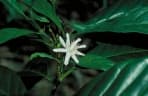
Coffea liberica
Coffea liberica
Safety & Hazards
None known
Cultivation Details
Liberian coffee is a plant of the humid, lowland tropics, where it performs better than arabica and robusta coffees[1, 2]. It is found at elevations up to 600 metres. It grows best in areas where annual daytime temperatures are within the range 24 - 30°c, but can tolerate 18 0 36°c[2]. It can be killed by temperatures of 5°c or lower[2]. It prefers a mean annual rainfall in the range 1,600 - 2,400mm, but tolerates 1,100 - 3,500mm[2]. Plants grow best under light shade, on well-drained clayey to sandy soils, although it is generally grown in full sunlight in Malaysia[1]. Plants are tolerant of acid and poor soils - they have been known to grow successfully on alluvial muck soils with a pH of about 4.0[1]. Prefers a pH in the range 5.3 - 6.2, tolerating 4.3 - 8[2]. Established plants, especially from the 'Excelsa' group of cultivars, are drought tolerant[1]. Plants are intolerant of waterlogged soils[1]. The first fruits are produced 2 - 3 years after planting out in the field. After 5 - 6 years the plants are in full bearing[1]. The economic life span of a plant is about 25 - 30 years[1]. Flowering and fruiting may take place throughout the year, but flowering is triggered by heavy showers; the flower buds grow to a certain size and then rest until stimulated by continued water stress and rapid rehydration, resulting in simultaneous blooming[1]. The species is self-incompatible[1]. Fruit maturation takes 10 - 12 months, depending on the locality[1] The weight of dry 'green beans' is about 10% of that of fresh fruits. Annual yields of 750 - 900, occasionally to 1,100 kg/ha of green beans can be obtained from well-maintained holdings. Improved cultivars have a potential annual yield of 1.7 t/ha and selected clones even 2.1 - 2.3 t/ha[1]. This is a complex species that has often been treated as a number of distinct species in the past[1]. Indeed, there is still debate amongst botanists as to whether it should be treated as two distinct species. From the growers point of view, however, there are clear differences between the two groups. The complex is here treated as one species with two main varieties:- var dewevrei (De Wild. & T. Durand) Lebrun. Known as 'Excelsa coffee', from the growers viewpoint this differs in being more drought tolerant and having a smaller fruit up to 20mm x 16mm[1]. Var liberica. Known as 'Liberian coffee'. The fruit is up to 25mm x 21mm, has a thicker, more leathery pericarp and is often more tapered towards the base[1] Although this species contributes only about 1% to total world coffee production, it is grown more extensively in southeast Asia with 80% of coffee production in Malaysia being of this species, for example, and about 25% in the Philippines[1].
Propagation
Propagation is usually by seed. The viability of the seeds is comparatively short, depending upon conditions, and it is advisable to plant within 2 months of harvesting. Seeds are sown in seedbeds prepared from alluvial sand, about 1.5 cm deep and 5 - 8 cm apart or in rows 30 cm apart. The seeds can be planted with the parchment attached but germination is quicker when it is removed[3]. Germination can take about 50 days[1], but the older the seeds, the longer they take to germinate[1]. Seedlings are planted in polythene bags 8 - 12 weeks after sowing when they have 2 - 4 pairs of leaves. They are transplanted into the field when they have developed 6 - 8 pairs of leaves, which under normal circumstances will be 8 - 10 months after sowing. The time of transplanting should ideally coincide with the onset of the rainy season. Seedlings can be raised in shaded nurseries, planting them out into their permanent positions when 6 - 12 months old[3]. Cuttings. Layering Air layering Grafting. Cite as: Tropical Plants Database, Ken Fern. tropical.theferns.info. 2026-02-20. <tropical.theferns.info/viewtropical.php?id=Coffea+liberica>
Pollinators
Data unavailable
References
- [1]Plant Resources of Southeast Asia — http://proseanet.org/ ↩︎Lots of information on the uses of the plants of SE Asia.
- [2]Ecocrop — http://ecocrop.fao.org/ecocrop/srv/en/home ↩︎Basic information on a wide range of useful plants, plus details of environmental needs where available.
- [3]World Agroforesty Centre — http://www.worldagroforestry.org/ ↩︎An excellent online database of a huge range of trees giving very good information on each plant - its uses, ecology, identity, propagation, pests etc.
- [4]Trade Winds Fruit — http://www.tradewindsfruit.com/index.htm ↩︎The on-line catalogue of a company selling seeds. Gives descriptions, photos and uses of a very wide range of fruit and other food-producing plants plus ornamentals.
- [5]Medicinal Plants of the Guianas — DeFilipps, R. A.; Maina, S. L.; & Crepin, J. · Smithsonian Museum · http://botany.si.edu/bdg/medicinal/index.html ↩︎A down-loadable PDF document of a book in pre-publication awaiting illustration. An excellent, if rather terse, guide to the traditional medicinal uses of the plants of the region