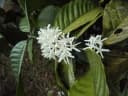
Coffea canephora
Coffea canephora
Safety & Hazards
None known
Cultivation Details
A plant of the moister tropics, where it is usually found at elevations between 200 - 800 metres, occasionally up to 1,300 metres[1, 2]. It grows best in areas where annual daytime temperatures are within the range 20 - 30°c, but can tolerate 12 - 36°c[2]. It can be killed by temperatures of 5°c or lower[2]. It prefers a mean annual rainfall in the range 1,700 - 3,000mm, but tolerates 900 - 4,000mm[2]. One to 2 months of less than 50mm rain facilitates uniform flowering[2]. Prefers a well-drained fertile, neutral to slightly acid soil[3]. Succeeds in shallow soils in areas of high rainfall, and will stand temporary waterlogging[2]. Prefers a pH in the range 5 - 6.3, tolerating 4 - 8[2]. Plants can tolerate 21 - 30 days of mild drought[2]. Plants can begin to flower and fruit within 3 - 4 years from seed. The yield increases up to the age of 14 years[2]. The plant has an economic life of 20 - 80 years (average 50 years), with declining yields. The tree may live as long as a hundred years. Well managed plantations may produce up to 2 tonnes per hectare of fresh berries[2]. A distinct dry season is favourable for flower initiation[4].
Propagation
Propagation is usually by seed. The viability of the seeds is comparatively short, depending upon conditions, and it is advisable to plant within 2 months of harvesting. The older the seeds, the longer they take to germinate and they lose viability. They can be planted with the parchment attached but germination is quicker when it is removed[1]. Seedlings can be raised in shaded nurseries, planting them out into their permanent positions when 6 - 12 months old[1]. Layering Air layering Budding. For rooting of coffee cuttings, the single leaf-bud cutting is commonly used[1]. Cite as: Tropical Plants Database, Ken Fern. tropical.theferns.info. 2026-02-20. <tropical.theferns.info/viewtropical.php?id=Coffea+canephora>
Pollinators
Data unavailable
References
- [1]World Agroforesty Centre — http://www.worldagroforestry.org/ ↩︎An excellent online database of a huge range of trees giving very good information on each plant - its uses, ecology, identity, propagation, pests etc.
- [2]Ecocrop — http://ecocrop.fao.org/ecocrop/srv/en/home ↩︎Basic information on a wide range of useful plants, plus details of environmental needs where available.
- [3]The New RHS Dictionary of Gardening. 1992. — Huxley. A. · MacMillan Press · 1992 · ISBN 0-333-47494-5 ↩︎Excellent and very comprehensive, though it contains a number of silly mistakes. Readable yet also very detailed.
- [4]Trees Commonly Cultivated in SE Asia — Jensen. M. · FAO Regional Office, Bangkok. · 1999 · ISBN 974-89377-5-5 ↩︎
- [5]Tropical and Subtropical Trees - A Worldwide Encyclopaedic Guide. — Barwick. M. · Thames & Hudson, London · 2004 · ISBN 0-500-51181-0 ↩︎A superb book, very concise and well written, giving a wealth of information on 400 or more species including descriptions, habitat, cultivation details and plant uses. A wealth of colour photographs bring each plant vividly to life.
- [6]Cornucopia II — Facciola. S. · Kampong Publications, California. · 1998 · ISBN 0-9628087-2-5 ↩︎The second edition of an excellent guide to the edible uses of plants, though it does not give any details of cultivation etc.
- [7]The Useful Plants of West Tropical Africa. — Burkil. H. M. · Royal Botanic Gardens; Kew. · 1985 - 2004 ↩︎Brief descriptions and details of the uses of over 4,000 plants. A superb, if terse, resource, it is also available electronically on the Web - see http://www.aluka.org/
- [8]Encyclopaedia of Herbs and their Uses. — Bown. D. · Dorling Kindersley, London. · 1995 · ISBN 0-7513-020-31 ↩︎A very well presented and informative book on herbs from around the globe. Plenty in it for both the casual reader and the serious student. Just one main quibble is the silly way of having two separate entries for each plant.
- [9]The Encyclopedia of Medicinal Plants — Chevallier. A. · Dorling Kindersley. London · 1996 · ISBN 9-780751-303148 ↩︎An excellent guide to over 500 of the more well known medicinal herbs from around the world.