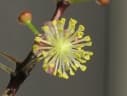
Euphorbiaceae FAMILY
Codiaeum variegatum
Codiaeum variegatum
Edibility
0/5
Medicinal
2/5
Safety & Hazards
This species may be poisonous if consumed in large quantities[1]. The bark, roots, latex and leaves are poisonous, containing the toxin called 5-deoxyingenol. Chewing the bark and roots is said to cause burning of the mouth[2]. The latex has caused eczema in some gardeners after repeated exposure[2].
Cultivation Details
HabitEvergreen Shrub
Growth—
Plants can succeed in full sun to fairly dense shade, depending upon the variety[3]. Requires a moist soil[3].
Propagation
Seed - Cuttings Cite as: Tropical Plants Database, Ken Fern. tropical.theferns.info. 2026-02-20. <tropical.theferns.info/viewtropical.php?id=Codiaeum+variegatum>
Pollinators
Data unavailable
References
- [1]Australian Tropical Rainforest Plants — http://www.anbg.gov.au/cpbr/cd-keys/rfk/index.html ↩︎An online resource giving botanical information, and a little bit about plant usage, for over 2,700 species of plants found in the Australian rainforest.
- [2]National Tropical Botanical Garden — http://ntbg.org/plants/choose_a_plant.php ↩︎General information on almost 400 species, with descriptions, habitats and some uses.
- [3]Desert Tropicals — http://www.desert-tropicals.com/ ↩︎The main focus of the site is succulent plants, but it also contains information on a wide range of other species. Usually at least one good photograph, plus basic information about the plant and its cultivation.
- [4]Flowers of India — http://www.flowersofindia.net/ ↩︎A wed site of native Indian plants, plus cultivated and naturalized species. It has good quality photos and terse details on more than 3,000 species and cultivars.
- [5]Philippine Medicinal Plants — http://www.stuartxchange.org/CompleteList.html ↩︎A lovely site, giving brief details on the medicinal uses of several hundred (over 400 at the last count) plants in the Philippines, plus a picture of each plant.
- [6]Medicinal Plants in Papua New Guinea — World Health Organisation · 2009 · ISBN 978-92-9061-249-0 ↩︎Traditional medicinal uses of 126 species from Papua New Guinea, including information on modern research into the plants.