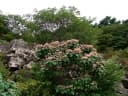
Clerodendrum trichotomum
Clerodendrum trichotomum
Safety & Hazards
None known
Cultivation Details
Clerodendrum trichotomum is found from the temperate zone, through the subtropics and just entering into the tropics in southern China. Plants are generally quite cold tolerant, often able to survive temperatures down to about -15°c, - they are likely to lose their top growth at such temperatures but will generally resprout from the base, especially if well mulched[1, 2, 3]. The sub-species C. Trichotomum fargesii. (Dode.)Rehder. Is somewhat hardier, tolerating temperatures down to about -20°c[2]. Succeeds in a sunny position in ordinary garden soil but prefers a fertile humus-rich well-drained loam[4, 3]. The soil must not be allowed to dry out in the growing season[5]. Requires a position sheltered from cold drying winds[5, 3]. Plants produce the occasional sucker[6]. The leaves have a heavy unpleasant odour when crushed[1, 6]. Flowers are produced on the current seasons growth and so, to encourage flowering, any pruning is best carried out when the plant is dormant[3]. The flowers are sweetly scented[3].
Propagation
Seed - best sown as soon as possible in a greenhouse. Germination can be erratic but usually takes place within 20 - 60 days at 20°c[4]. When large enough to handle, prick the seedlings out into individual pots and grow them on in the greenhouse for at least their first winter. Plant them out in late spring or early summer after the last expected frosts. Root cuttings, 6 - 8cm long, December in a greenhouse. High percentage[7]. Division of suckers in the dormant season. Very easy, they can be planted out direct into their permanent positions if required. Cite as: Temperate Plants Database, Ken Fern. temperate.theferns.info. 2026-02-20. <temperate.theferns.info/plant/Clerodendrum+trichotomum>
Pollinators
Insects
References
- [1]Trees and Shrubs Hardy in Great Britain. Vol 1 - 4 and Supplement. — Bean. W. · Murray · 1981 · ISBN - ↩︎A classic with a wealth of information on the plants, but poor on pictures.
- [2]Shrubs. — Phillips. R. & Rix. M. · Pan Books · 1989 · ISBN 0-330-30258-2 ↩︎Excellent photographs and a terse description of 1,900 species and cultivars.
- [3]The New RHS Dictionary of Gardening. 1992. — Huxley. A. · MacMillan Press · 1992 · ISBN 0-333-47494-5 ↩︎Excellent and very comprehensive, though it contains a number of silly mistakes. Readable yet also very detailed.
- [4]Growing from Seed. Volume 4. — Bird. R. (Editor) · Thompson and Morgan. · 1990 · ISBN - ↩︎Very readable magazine with lots of information on propagation. A good article on Yuccas, one on Sagebrush (Artemesia spp) and another on Chaerophyllum bulbosum.
- [5]RHS Dictionary of Plants plus Supplement. 1956 — F. Chittendon. · Oxford University Press · 1951 · ISBN - ↩︎Comprehensive listing of species and how to grow them. Somewhat outdated, it has been replaced in 1992 by a new dictionary (see [ 200 ]).
- [6]Ornamental Shrubs, Climbers and Bamboos. — Thomas. G. S. · Murray · 1992 · ISBN 0-7195-5043-2 ↩︎Contains a wide range of plants with a brief description, mainly of their ornamental value but also usually of cultivation details and varieties.
- [7]Propagation of Trees, Shrubs and Conifers. — Sheat. W. G. · MacMillan and Co · 1948 · ISBN - ↩︎A bit dated but a good book on propagation techniques with specific details for a wide range of plants.
- [8]Flora of China — Missouri Botanical Garden Press; St. Louis. · 1994 · http://flora.huh.harvard.edu/china/ ↩︎An excellent, comprehensive resource in 25 volumes. In addition to the botanical information the flora also gives basic information on habitat and some uses. An on-line version is also available.
- [9]Tanaka's Cyclopedia of Edible Plants of the World. — Tanaka. T. & Nakao S. · Keigaku Publishing; Tokyo · 1976 · ISBN - ↩︎The most comprehensive list of edible plants I've come across. Only the briefest entry for each species, though, and some of the entries are more than a little dubious. Not for the casual reader.
- [10]Plants for Human Consumption. — Kunkel. G. · Koeltz Scientific Books · 1984 · ISBN 3874292169 ↩︎An excellent book for the dedicated. A comprehensive listing of Latin names with a brief list of edible parts.
- [11]Handbook of Chinese Herbs and Formulas. — Yeung. Him-Che. · Institute of Chinese Medicine, Los Angeles · 1985 · ISBN - ↩︎An excellent Chinese herbal giving information on over 500 species. Rather technical and probably best suited to the more accomplished user of herbs.
- [12]Medicinal Plants of China — Duke. J. A. and Ayensu. E. S. · Reference Publications, Inc. · 1985 · ISBN 0-917256-20-4 ↩︎Details of over 1,200 medicinal plants of China and brief details of their uses. Often includes an analysis, or at least a list of constituents. Heavy going if you are not into the subject.
- [13]The Encyclopedia of Medicinal Plants — Chevallier. A. · Dorling Kindersley. London · 1996 · ISBN 9-780751-303148 ↩︎An excellent guide to over 500 of the more well known medicinal herbs from around the world.
- [14]A Barefoot Doctors Manual. — ? · Running Press; Philadelphica. · 1977 · ISBN 0-914294-92-X ↩︎A very readable herbal from China, combining some modern methods with traditional chinese methods.
- [15]CosIng — http://ec.europa.eu/growth/tools-databases/cosing/ ↩︎CosIng is the European Commission database for information on cosmetic substances and ingredients.
- [PFAF]Plants for a Future — pfaf.org ↩︎