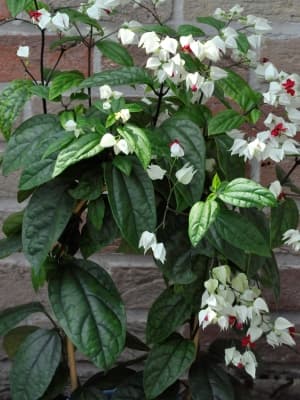
Clerodendrum thomsoniae
Clerodendrum thomsoniae
Safety & Hazards
None known
Cultivation Details
Succeeds in full sun and in partial shade, preferring a moist, fertile, well-drained soil[1]. Plants can tolerate pretty dry growing conditions and established plants are drought resistant[1, 2]. Clerodendrum thomsoniae is widely cultivated as an ornamental, and is known to be naturalized in many introduced places including the Americas, the Galapagos Islands, and Australia. The species is listed in the Global Compendium of Weeds as an environmental weed but does not appear to be a Clerodendrum species with high risk of introduction based on current evidence[3]. Plants can flower all year round[1].
Propagation
Seed - best sown as soon as it is ripe. Germination can be erratic but usually takes place within 20 - 60 days at 20°c[4]. When large enough to handle, prick the seedlings out into individual pots and grow them on until large enough to plant out. Root cuttings, 6 - 8cm long usually grow away well[5]. Division of suckers in the dormant season. Very easy, they can be planted out direct into their permanent positions if required. Cite as: Tropical Plants Database, Ken Fern. tropical.theferns.info. 2026-02-20. <tropical.theferns.info/viewtropical.php?id=Clerodendrum+thomsoniae>
Pollinators
Lepidoptera, Bees
References
- [1]Tropical Ornamentals; A Guide — Whistler. W. Arthur. · Timber Press Inc. Oregon. · 2000 · ISBN 0-88192-448-2 ↩︎An excellent little guide to some of the more commonly cultivated ornamental plants of the Tropics, often giving some information on the plants other uses.
- [2]Flowers of India — http://www.flowersofindia.net/ ↩︎A wed site of native Indian plants, plus cultivated and naturalized species. It has good quality photos and terse details on more than 3,000 species and cultivars.
- [3]Invasive Species Compendium — http://www.cabi.org ↩︎An immense resource - in depth information on over 900 species of invasive plants (it also has information on animals, fungi etc).
- [4]Growing from Seed. Volume 4. — Bird. R. (Editor) · Thompson and Morgan. · 1990 · ISBN - ↩︎Very readable magazine with lots of information on propagation. A good article on Yuccas, one on Sagebrush (Artemesia spp) and another on Chaerophyllum bulbosum.
- [5]Propagation of Trees, Shrubs and Conifers. — Sheat. W. G. · MacMillan and Co · 1948 · ISBN - ↩︎A bit dated but a good book on propagation techniques with specific details for a wide range of plants.
- [6]The New RHS Dictionary of Gardening. 1992. — Huxley. A. · MacMillan Press · 1992 · ISBN 0-333-47494-5 ↩︎Excellent and very comprehensive, though it contains a number of silly mistakes. Readable yet also very detailed.
- [7]Encyclopedia of Tropical Plants - Identification and Cultivation of over 3,000 Tropical Plants — Ahmed Fayaz · Firefly Books Ltd.; New Zealand · 2011 · ISBN 978-1-55407-489 ↩︎A good photograph and terse but detailed information for over 3,000 species of tropical plants. An excellent reference.
- [8]Medicinal Plants of the Guianas — DeFilipps, R. A.; Maina, S. L.; & Crepin, J. · Smithsonian Museum · http://botany.si.edu/bdg/medicinal/index.html ↩︎A down-loadable PDF document of a book in pre-publication awaiting illustration. An excellent, if rather terse, guide to the traditional medicinal uses of the plants of the region
- [9]Journal of Ethnobiology Vol 17 — Eugene S. Hunn (Editor) · Society of Ethnobiology; Seattle. · 1997 - 1998 ↩︎A series of articles on the various ways humans use plants. It can be downloaded from the Internet.