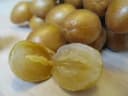
Clausena lansium
Clausena lansium
Safety & Hazards
None known
Cultivation Details
A plant of the subhumid to humid tropics, where it is found at elevations up to 2,450 metres. It is also cultivated in the subtropics[1]. It grows best in areas where annual daytime temperatures are within the range 22 - 30°c, but can tolerate 12 - 35°c[2]. The plant can survive short-lived frosts down to about -2°c, but can be killed by temperatures of -7°c or lower[1, 2]. It prefers a mean annual rainfall in the range 2,000 - 3,000mm, but tolerates 1,000 - 4,000mm[2]. Prefers a sunny position in most fertile soils[3]. Plants seem to tolerate a range of soils including the deep sand and oolitic limestone derived soils, but they thrive best in rich loams[1]. Requires a well-drained soil[1]. Prefers a pH in the range 5 - 6, tolerating 4.5 - 6.5[2]. Plants can start flowering and fruiting when 5 - 8 years old from seed[4]. Well-developed mature trees can produce up to 45 kg fruits per season[2] There are some named varieties[5] The leaves have a pleasant anise scent when bruised[3, 6].
Propagation
Seed - germination occurs in a few days[1]. Greenwood cuttings Semi-ripe cuttings Air layering Veneer-grafted onto seedlings of the same species[1]. The plant can be grafted onto some citrus rootstock, but long-term survivability is questionable[4]. Cite as: Tropical Plants Database, Ken Fern. tropical.theferns.info. 2026-02-20. <tropical.theferns.info/viewtropical.php?id=Clausena+lansium>
Pollinators
Data unavailable
References
- [1]Under-Utilized Tropical Fruits of Thailand. RAP — Suranant Subhadrabandhu · F. A. O., The United Nations, Bangkok. · 2001 · http://www.fao.org/3/a-ab777e.pdf ↩︎A detailed report on 35 fruit species that could have potential for increased production in Thailand. The report can be downloadd as a PDF from the internet.
- [2]Ecocrop — http://ecocrop.fao.org/ecocrop/srv/en/home ↩︎Basic information on a wide range of useful plants, plus details of environmental needs where available.
- [3]The New RHS Dictionary of Gardening. 1992. — Huxley. A. · MacMillan Press · 1992 · ISBN 0-333-47494-5 ↩︎Excellent and very comprehensive, though it contains a number of silly mistakes. Readable yet also very detailed.
- [4]Trade Winds Fruit — http://www.tradewindsfruit.com/index.htm ↩︎The on-line catalogue of a company selling seeds. Gives descriptions, photos and uses of a very wide range of fruit and other food-producing plants plus ornamentals.
- [5]Cornucopia II — Facciola. S. · Kampong Publications, California. · 1998 · ISBN 0-9628087-2-5 ↩︎The second edition of an excellent guide to the edible uses of plants, though it does not give any details of cultivation etc.
- [6]Tropical and Subtropical Trees - A Worldwide Encyclopaedic Guide. — Barwick. M. · Thames & Hudson, London · 2004 · ISBN 0-500-51181-0 ↩︎A superb book, very concise and well written, giving a wealth of information on 400 or more species including descriptions, habitat, cultivation details and plant uses. A wealth of colour photographs bring each plant vividly to life.
- [7]Brazilian Fruits and Cultivated Exotics — Lorenzi. H.; Bacher. L.; Lacerda. M.; Sartori. S. · Instituto Plantarum De Estudos Da Flora LTDA; Brazil. · 2000 · ISBN 85-867174-24-0 ↩︎A superb book, giving information on several hundred fruit species. Each entry has a brief description of the plant and its uses, accompanied by one to many excellent quality photographs of the fruits.
- [8]Plant Resources of Southeast Asia — http://proseanet.org/ ↩︎Lots of information on the uses of the plants of SE Asia.
- [9]Flora of China — Missouri Botanical Garden Press; St. Louis. · 1994 · http://flora.huh.harvard.edu/china/ ↩︎An excellent, comprehensive resource in 25 volumes. In addition to the botanical information the flora also gives basic information on habitat and some uses. An on-line version is also available.
- [10]Mansfeld's Database of Agricultural and Horticultural Plants — http://mansfeld.ipk-gatersleben.de/pls/htmldb_pgrc/f?p=185:3:4292127278597336 ↩︎Terse details of a huge range of useful plants.
- [11]The Botany of Citrus and Its Wild Relatives — Swingle. W.T. · http://lib.ucr.edu/agnic/webber/Vol1/Chapter3.html ↩︎An on-line document giving lots of information about Citrus species and their relatives. A bit dated, but still an incredibly detailed work.