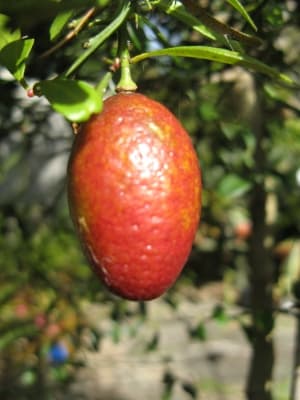
Citrus limonia
Citrus limonia
Safety & Hazards
None known
Cultivation Details
Three main climates are suitable for commercial citrus production - tropical climates, subtropical with winter rain such as in the Mediterranean and semitropical with summer rainfall as found in Florida and southern Brazil[1]. The optimal temperatures for citrus cultivation range between 25 - 30°c, with the coldest month having an average minimum of at least 15°c[1]. Growth generally ceases below 13°c and above 38°c[1]. If there are dry periods of more than three months, then irrigation will be necessary[1]. Prefers a deep, well-drained but moisture-retentive loamy soil in full sun[1]. Prefers a pH in the range 5 - 6[1].
Propagation
The seed is best sown in containers as soon as it is ripe, after thoroughly rinsing it[2, 1]. Sow stored seed in containers as soon as possible]. Germination usually takes place within 2 - 3 weeks at 13°c. Seedlings are liable to damp off so they must be watered with care and kept well ventilated. The seed is usually polyembrionic, two or more seedlings arise from each seed and they are genetically identical to the parent but they do not usually carry any virus that might be present in the parent plant[1]. When large enough to handle, prick the seedlings out into individual pots and grow them on until they are 10cm or more tall before planting out into their permanent positions. Cuttings of half-ripe wood, July/August in a frame. This species grows easily from cuttings[1]. Layering in October. Cite as: Tropical Plants Database, Ken Fern. tropical.theferns.info. 2026-02-20. <tropical.theferns.info/viewtropical.php?id=Citrus+limonia>
Pollinators
Data unavailable
References
- [1]The New RHS Dictionary of Gardening. 1992. — Huxley. A. · MacMillan Press · 1992 · ISBN 0-333-47494-5 ↩︎Excellent and very comprehensive, though it contains a number of silly mistakes. Readable yet also very detailed.
- [2]Growing from Seed. Volume 4. — Bird. R. (Editor) · Thompson and Morgan. · 1990 · ISBN - ↩︎Very readable magazine with lots of information on propagation. A good article on Yuccas, one on Sagebrush (Artemesia spp) and another on Chaerophyllum bulbosum.
- [3]Brazilian Fruits and Cultivated Exotics — Lorenzi. H.; Bacher. L.; Lacerda. M.; Sartori. S. · Instituto Plantarum De Estudos Da Flora LTDA; Brazil. · 2000 · ISBN 85-867174-24-0 ↩︎A superb book, giving information on several hundred fruit species. Each entry has a brief description of the plant and its uses, accompanied by one to many excellent quality photographs of the fruits.
- [4]Mansfeld's Database of Agricultural and Horticultural Plants — http://mansfeld.ipk-gatersleben.de/pls/htmldb_pgrc/f?p=185:3:4292127278597336 ↩︎Terse details of a huge range of useful plants.
- [5]Cornucopia II — Facciola. S. · Kampong Publications, California. · 1998 · ISBN 0-9628087-2-5 ↩︎The second edition of an excellent guide to the edible uses of plants, though it does not give any details of cultivation etc.
- [6]Dictionary of Economic Plants. — Uphof. J. C. Th. · Weinheim · 1959 · ISBN - ↩︎An excellent and very comprehensive guide but it only gives very short descriptions of the uses without any details of how to utilize the plants. Not for the casual reader.
- [7]Medicinal Plants in Vietnam — Nguyen Van Dan & Doan Thi Nhu · World Health Organisation · 1989 · ISBN 92 9061 101 4 ↩︎An excellent book, giving information on over 200 plants, their medicinal compounds and applications.
- [8]Encyclopaedia of Herbs and their Uses. — Bown. D. · Dorling Kindersley, London. · 1995 · ISBN 0-7513-020-31 ↩︎A very well presented and informative book on herbs from around the globe. Plenty in it for both the casual reader and the serious student. Just one main quibble is the silly way of having two separate entries for each plant.