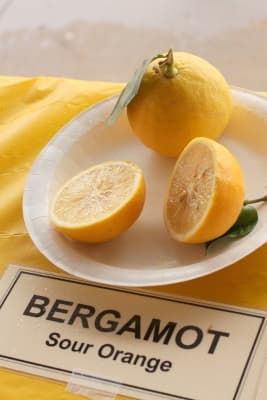
Citrus bergamia
Citrus bergamia
Safety & Hazards
Bergamot essential oil contains bergapten which may cause skin irritation and photosensitivity and is thus a danger in sunscreen products[1]. Bergamot oil NS (non-sensitizing) has been developed to overcome this risk; terpeneless grades produced by vacuum distilling whole oil can also be used[1].
Cultivation Details
Three main climates are suitable for commercial citrus production - tropical climates, subtropical with winter rain such as in the Mediterranean and semitropical with summer rainfall as found in Florida and southern Brazil[2]. The optimal temperatures for citrus cultivation range between 25 - 30°c, with the coldest month having an average minimum of at least 15°c[2]. Growth generally ceases below 13°c and above 38°c[2]. If there are dry periods of more than three months, then irrigation will be necessary[2]. Prefers a deep, well-drained but moisture-retentive loamy soil in full sun[2]. Prefers a pH in the range 5 - 6.5, tolerating 6 - 8[2, 3]. Although it was long thought that bergamot was adapted to a narrowly defined climate, as found specifically in Calabria, Italy, the plant has proven to grow well in tropical conditions too, such as in Ivory Coast[1]. Bergamot is most probably of hybrid origin[1]. It has been suggested that it is a hybrid between sour orange (C. Aurantium) and lemon (C. Limon), or a mutation of the latter[1]. Others hold it as a hybrid between sour orange and lime (C. Aurantifolia)[1]. Bergamot is only known from cultivation and consists of a limited and well defined number of cultivars. Four cultivar groups are recognized:- Common Bergamot. Only this form is commercially cultivated for the essential oil[1]. Melarosa. The fruit is rather flattened. Torulosa. The fruit is ridged Piccola. Dwarf cultivars.
Propagation
The seed is best sown in containers as soon as it is ripe, after thoroughly rinsing it[4, 2]. Sow stored seed in containers as soon as possible]. Germination usually takes place within 2 - 3 weeks at 13°c. Seedlings are liable to damp off so they must be watered with care and kept well ventilated. The seed is usually polyembryonic, two or more seedlings arise from each seed and they are genetically identical to the parent but they do not usually carry any virus that might be present in the parent plant[2]. When large enough to handle, prick the seedlings out into individual pots and grow them on until they are 10cm or more tall before planting out into their permanent positions. Cuttings of half-ripe wood, July/August in a frame. This species grows easily from cuttings[2]. Layering in October. Cite as: Tropical Plants Database, Ken Fern. tropical.theferns.info. 2026-02-20. <tropical.theferns.info/viewtropical.php?id=Citrus+bergamia>
Pollinators
Data unavailable
References
- [1]World Agroforesty Centre — http://www.worldagroforestry.org/ ↩︎An excellent online database of a huge range of trees giving very good information on each plant - its uses, ecology, identity, propagation, pests etc.
- [2]The New RHS Dictionary of Gardening. 1992. — Huxley. A. · MacMillan Press · 1992 · ISBN 0-333-47494-5 ↩︎Excellent and very comprehensive, though it contains a number of silly mistakes. Readable yet also very detailed.
- [3]Ecocrop — http://ecocrop.fao.org/ecocrop/srv/en/home ↩︎Basic information on a wide range of useful plants, plus details of environmental needs where available.
- [4]Growing from Seed. Volume 4. — Bird. R. (Editor) · Thompson and Morgan. · 1990 · ISBN - ↩︎Very readable magazine with lots of information on propagation. A good article on Yuccas, one on Sagebrush (Artemesia spp) and another on Chaerophyllum bulbosum.
- [5]Mansfeld's Database of Agricultural and Horticultural Plants — http://mansfeld.ipk-gatersleben.de/pls/htmldb_pgrc/f?p=185:3:4292127278597336 ↩︎Terse details of a huge range of useful plants.
- [6]Encyclopaedia of Herbs and their Uses. — Bown. D. · Dorling Kindersley, London. · 1995 · ISBN 0-7513-020-31 ↩︎A very well presented and informative book on herbs from around the globe. Plenty in it for both the casual reader and the serious student. Just one main quibble is the silly way of having two separate entries for each plant.
- [7]Cornucopia II — Facciola. S. · Kampong Publications, California. · 1998 · ISBN 0-9628087-2-5 ↩︎The second edition of an excellent guide to the edible uses of plants, though it does not give any details of cultivation etc.