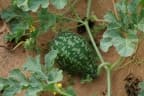
Citrullus lanatus
Citrullus lanatus
Safety & Hazards
The sprouting seed produces a toxic substance in its embryo[1].
Cultivation Details
Water melon is a plant of the drier tropics, though it can be cultivated from the moist tropics to the warm temperate zones. In the tropics it can be found at elevations up to 1,000 metres. It grows best in areas where annual daytime temperatures are within the range 20 - 35°c, but can tolerate 15 - 40°c[2]. The plant is not frost hardy and requires a long hot summer if it is to fruit well outside the tropics. It prefers a mean annual rainfall in the range 500 - 700mm, but tolerates 400 - 1,800mm[2]. Plants grow best in dry, sunny periods - excessive moisture and high humidity reduce flowering and lead to leaf diseases[3]. Temperatures above 30°c can reduce fertilization and lead to lower yields[3]. It prefers regions with stable day/night temperatures[3]. Prefers an organic-rich sandy loam and a very sunny position[4, 5, 6, 3]. Prefers a pH in the range 6 - 7, tolerating 5.5 - 7.5[2]. A drought resistant plant once established, it is intolerant of wet soils[5]. In general, fruit harvest commences 80 - 110 days from sowing, continuing for a further 40 - 50 days[2]. The yield of seeds from the bitter melons can vary considerably from 250kg per hectare to over 3,000kg depending on cultivar and soil. Yields of watermelon fruits can vary from 5 - 60 tonnes per hectare, with an average around 25 tonnes[7]. Yields of the cooking melons have exceeded 100 tonnes per hectare in trials[7]. Three main types of water melon are grown:- Sweet varieties (also known as subsp vulgaris). These are often 30cm or more in diameter and contain a sweet, very juicy flesh that is eaten raw. This is the form of water melon that is best known outside of Africa[7]. Bitter forms (also known as subsp mucosospermus). This form has a bitter-tasting almost inedible flesh, and is grown mainly for its edible seeds. Widely used in Africa, though little known elsewhere[7]. Cooking forms (also known as subsp lanatus). Neither sweet nor bitter, these forms are used as a vegetable, usually being cooked when immature[7]. There are many named varieties[8, 9]. The cultivars 'Fordbrook hybrid', New Hampshire midget' and 'Sugar baby' commence bearing in 80 - 85 days in Long Island, New York[6]. A good companion plant for potatoes[10].
Propagation
Seed - sow spring in a rich compost in a greenhouse. Either put 2-3 seeds in each pot and thin to the best plant, or prick out the seedlings into individual pots of rich soil as soon as they are large enough to handle. Grow them on fast and, if trying them outside, plant out after the last expected frosts. Give them some protection, such as a cloche or a frame, at least until they are growing away vigorously. Cite as: Temperate Plants Database, Ken Fern. temperate.theferns.info. 2026-02-20. <temperate.theferns.info/plant/Citrullus+lanatus>
Pollinators
Insects
References
- [1]A Colour Atlas of Poisonous Plants. — Frohne. D. and Pfänder. J. · Wolfe · 1984 · ISBN 0723408394 ↩︎Brilliant. Goes into technical details but in a very readable way. The best work on the subject that I've come across so far.
- [2]Ecocrop — http://ecocrop.fao.org/ecocrop/srv/en/home ↩︎Basic information on a wide range of useful plants, plus details of environmental needs where available.
- [3]Vegetables in the Tropics — Tindall. H. D. · MacMillan, Oxford. · 1983 · ISBN 0-333-24268-8 ↩︎An excellent, in-depth look at the main vegetable crops that can be grown in the Tropics, plus many less well-known plants.
- [4]RHS Dictionary of Plants plus Supplement. 1956 — F. Chittendon. · Oxford University Press · 1951 · ISBN - ↩︎Comprehensive listing of species and how to grow them. Somewhat outdated, it has been replaced in 1992 by a new dictionary (see [ 200 ]).
- [5]The Book of Edible Nuts. — Rosengarten. jnr. F. · Walker & Co. · 1984 · ISBN 0802707699 ↩︎A very readable and comprehensive guide. Well illustrated.
- [6]The New RHS Dictionary of Gardening. 1992. — Huxley. A. · MacMillan Press · 1992 · ISBN 0-333-47494-5 ↩︎Excellent and very comprehensive, though it contains a number of silly mistakes. Readable yet also very detailed.
- [7]Protabase - Plant Resources of Tropical Africa. — http://www.prota.org ↩︎An excellent on-line database with detailed information on over 3,200 species of useful plants of Africa.
- [8]Cornucopia - A Source Book of Edible Plants. — Facciola. S. · Kampong Publications · 1990 · ISBN 0-9628087-0-9 ↩︎Excellent. Contains a very wide range of conventional and unconventional food plants (including tropical) and where they can be obtained (mainly N. American nurseries but also research institutes and a lot of other nurseries from around the world.
- [9]Cornucopia II — Facciola. S. · Kampong Publications, California. · 1998 · ISBN 0-9628087-2-5 ↩︎The second edition of an excellent guide to the edible uses of plants, though it does not give any details of cultivation etc.
- [10]Companion Planting for Successful Gardening. — Riotte. L. · Garden Way, Vermont, USA. · 1978 · ISBN 0-88266-064-0 ↩︎Fairly good.
- [11]Sturtevant's Edible Plants of the World. — Hedrick. U. P. · Dover Publications · 1972 · ISBN 0-486-20459-6 ↩︎Lots of entries, quite a lot of information in most entries and references.
- [12]Alternative Foods. — Sholto-Douglas. J. ↩︎Not very comprehensive, it seems more or less like a copy of earlier writings with little added.
- [13]Dictionary of Economic Plants. — Uphof. J. C. Th. · Weinheim · 1959 · ISBN - ↩︎An excellent and very comprehensive guide but it only gives very short descriptions of the uses without any details of how to utilize the plants. Not for the casual reader.
- [14]Medicinal Plants of China — Duke. J. A. and Ayensu. E. S. · Reference Publications, Inc. · 1985 · ISBN 0-917256-20-4 ↩︎Details of over 1,200 medicinal plants of China and brief details of their uses. Often includes an analysis, or at least a list of constituents. Heavy going if you are not into the subject.
- [15]Glossary of Indian Medicinal Plants (Including the Supplement). — Chopra. R. N., Nayar. S. L. and Chopra. I. C. · Council of Scientific and Industrial Research, New Delhi. · 1986 · ISBN - ↩︎Very terse details of medicinal uses of plants with a wide range of references and details of research into the plants chemistry. Not for the casual reader.
- [16]A - Z of Companion Planting. — Allardice.P. · Cassell Publishers Ltd. · 1993 · ISBN 0-304-34324-2 ↩︎A well produced and very readable book.
- [17]Nuts. — Howes. F. N. · Faber · 1948 · ISBN - ↩︎Rather old but still a masterpiece. Has sections on tropical and temperate plants with edible nuts plus a section on nut plants in Britain. Very readable.
- [18]Gourds. — Organ. J. · Faber · 1963 · ISBN - ↩︎Deals with squashes and their relatives. Interesting and readable, it gives cultivation techniques and some details of plant uses.
- [19]Lilies and Related Plants. — RHS Lily Group. ↩︎Lots of interesting snippets about plants in the family Liliaceae (in the old, broad sense)
- [20]Tanaka's Cyclopedia of Edible Plants of the World. — Tanaka. T. & Nakao S. · Keigaku Publishing; Tokyo · 1976 · ISBN - ↩︎The most comprehensive list of edible plants I've come across. Only the briefest entry for each species, though, and some of the entries are more than a little dubious. Not for the casual reader.
- [21]Handbook of Cultivated Sedums. — Evans. R. L. · Science Reviews · 1983 · ISBN - ↩︎Deals with the genus Sedum. Fairly easy reading, it gives cultivation details and some notes on habitats.
- [22]A Dictionary of Plants Used by Man. — Usher. G. · Constable · 1974 · ISBN 0094579202 ↩︎Forget the sexist title, this is one of the best books on the subject. Lists a very extensive range of useful plants from around the world with very brief details of the uses. Not for the casual reader.
- [23]Flora of China — Missouri Botanical Garden Press; St. Louis. · 1994 · http://flora.huh.harvard.edu/china/ ↩︎An excellent, comprehensive resource in 25 volumes. In addition to the botanical information the flora also gives basic information on habitat and some uses. An on-line version is also available.
- [24]A Modern Herbal. — Grieve. · Penguin · 1984 · ISBN 0-14-046-440-9 ↩︎Not so modern (1930's?) but lots of information, mainly temperate plants.
- [25]Native American Ethnobotany — Moerman. D. · Timber Press. Oregon. · 1998 · ISBN 0-88192-453-9 ↩︎Very comprehensive but terse guide to the native uses of plants. Excellent bibliography, fully referenced to each plant, giving a pathway to further information. Not for the casual reader.
- [26]Encyclopaedia of Medicinal Plants. — Chiej. R. · MacDonald · 1984 · ISBN 0-356-10541-5 ↩︎Covers plants growing in Europe. Also gives other interesting information on the plants. Good photographs.
- [27]Medicinal Plants of the Guianas — DeFilipps, R. A.; Maina, S. L.; & Crepin, J. · Smithsonian Museum · http://botany.si.edu/bdg/medicinal/index.html ↩︎A down-loadable PDF document of a book in pre-publication awaiting illustration. An excellent, if rather terse, guide to the traditional medicinal uses of the plants of the region
- [28]AM — Radio 4 · - · 1997 · ISBN - ↩︎A news item on the Radio 4 morning news programme 'AM', 15/10/97.
- [29]Oil Yielding Plants — Botanical Survey of India. · 2004 · http://mnes.nic.in/list/oil-plants.pdf ↩︎A PDF downloaded from the Internet. Very terse details about the applications of oil obtained from over 300 species of plants.
- [PFAF]Plants for a Future — pfaf.org ↩︎