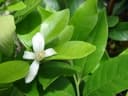
Citrofortunella x microcarpa
Citrofortunella x microcarpa
Safety & Hazards
None known
Cultivation Details
Requires a position in full sun in a fertile well-drained but not dry soil[1]. Prefers a moderately heavy loam with a generous amount of compost and sand added and a very sunny position[2, 3]. When growing plants in pots, a compost comprising equal quantities of loam and leafmould plus a little charcoal should produce good results[4]. Do not use manure since Citrus species dislike it[4]. When watering pot plants it is important to neither overwater or underwater since the plant will soon complain by turning yellow and dying. Water only when the compost is almost dry, but do not allow it to become completely dry[4]. Plants are not very hardy in Britain but they do tolerate a few degrees of frost[3], so it should be possible to grow them in selected areas in the mildest parts of the country[PFAF]. So long as the temperature falls gradually over a period of several days to allow the plant to become dormant, this species can tolerate short periods where temperatures fall to about -6°c[4]. Plants are susceptible to lime-induced and magnesium-deficiency chlorosis[1]. A popular house plant[3], pot-grown specimens less than 30cm tall can carry a dozen or more fruits[PFAF]. There are several named varieties, selected both for ornament and for fruit[5, 3].
Propagation
The following notes are based on Citrus species. They are probably applicable here as well, even though this is a bi-generic hybrid, since any seed might be produced polyembrionically. The seed is best sown in a greenhouse as soon as it ripe after thoroughly rinsing it[6, 3]. Sow stored seed in early spring in a greenhouse[7]. Germination usually takes place within 2 - 3 weeks at 13°c. Seedlings are liable to damp off so they must be watered with care and kept well ventilated. The seed is usually polyembrionic, two or more seedlings arise from each seed and they are genetically identical to the parent but they do not usually carry any virus that might be present in the parent plant[3]. When large enough to handle, prick the seedlings out into individual pots and grow them on in the greenhouse for at least three growing seasons before trying them outdoors. Plant them out in the summer and give them some protection from the cold for their first few winters outdoors. Cuttings of half-ripe wood, mid summer in a frame. Layering in early autumn. Cite as: Temperate Plants Database, Ken Fern. temperate.theferns.info. 2026-02-20. <temperate.theferns.info/plant/Citrofortunella+x+microcarpa>
Pollinators
Data unavailable
References
- [1]The RHS Gardener's Encyclopedia of Plants and Flowers — Brickell. C. · Dorling Kindersley Publishers Ltd. · 1990 · ISBN 0-86318-386-7 ↩︎Excellent range of photographs, some cultivation details but very little information on plant uses.
- [2]RHS Dictionary of Plants plus Supplement. 1956 — F. Chittendon. · Oxford University Press · 1951 · ISBN - ↩︎Comprehensive listing of species and how to grow them. Somewhat outdated, it has been replaced in 1992 by a new dictionary (see [ 200 ]).
- [3]The New RHS Dictionary of Gardening. 1992. — Huxley. A. · MacMillan Press · 1992 · ISBN 0-333-47494-5 ↩︎Excellent and very comprehensive, though it contains a number of silly mistakes. Readable yet also very detailed.
- [4]Conservatory and Indoor Plants Volumes 1 & 2 — Phillips. R. & Rix. M. · Pan Books, London. · 1998 · ISBN 0-330-37376-5 ↩︎Excellent photos of over 1,100 species and cultivars with habits and cultivation details plus a few plant uses. Many species are too tender for outdoors in Britain though there are many that can be grown outside.
- [5]Cornucopia - A Source Book of Edible Plants. — Facciola. S. · Kampong Publications · 1990 · ISBN 0-9628087-0-9 ↩︎Excellent. Contains a very wide range of conventional and unconventional food plants (including tropical) and where they can be obtained (mainly N. American nurseries but also research institutes and a lot of other nurseries from around the world.
- [6]Growing from Seed. Volume 4. — Bird. R. (Editor) · Thompson and Morgan. · 1990 · ISBN - ↩︎Very readable magazine with lots of information on propagation. A good article on Yuccas, one on Sagebrush (Artemesia spp) and another on Chaerophyllum bulbosum.
- [7]Growing Unusual Fruit. — Simmons. A. E. · David & Charles; Newton Abbot. · 1972 · ISBN 0-7153-5531-7 ↩︎A very readable book with information on about 100 species that can be grown in Britain (some in greenhouses) and details on how to grow and use them.
- [PFAF]Plants for a Future — pfaf.org ↩︎