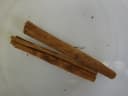
Cinnamomum verum
Cinnamomum verum
Safety & Hazards
None known
Cultivation Details
Cinnamon can be found at elevations up to 2,000 metres, but for commercial harvesting does best at low altitudes below 500 metres[1, 2]. It requires a warm and wet climate with an average temperatures of about 27°c and no extremes of heat or cold[1]. Rainfall should be around 2,000 - 2,500mm, well-distributed throughout the year[1]. Although there can be months in which there is less rain, no prolonged dry season should occur and rain should be received on about 150 days per year[1]. Prefers a fertile, sandy, moisture-retentive but freely draining soil in full sun or partial shade[3, 4]. Rocky and stony ground is unsuitable[1]. Waterlogged and marshy areas should be avoided, as they result in an undesirable, bitter product, which is much less aromatic[1]. The type of soil has a pronounced effect on bark quality[1]. Fine sandy and lateritic gravelly soils rather than rocky and stony substrates are best in Sri Lanka and India, but in the Seychelles and Madagascar more loamy soils are preferred[1]. Prefers a pH in the range 5.5 - 6.5, tolerating 5 - 7[2]. The tree usually coppices well[1]. Commercial production of cinnamon bark entails cutting the stems down low after an initial establishment period and harvesting the bushy regrowth stems at regular intervals thereafter[1]. Stems are cut during the rainy season to facilitate peeling of the bark in 2 longitudinal strips[1]. In Sri Lanka, a first harvest may be obtained after 3 - 4 years, although quality and yield improve with subsequent cuttings[1]. On plantations, cinnamon is cut every 2 years, and the flush of straight shoots generated by coppicing produces the bark that is peeled for cinnamon quills[1]. The expected yield of bark is 56 - 67 kg/ha after 3 - 4 years, subsequently increasing to 168 - 224 kg/ha[2]. About 63 kg/ha of chips and approximately 2.5 tonnes/ha of undried leaves can also be obtained[2].
Propagation
Seed - the seed has a short viability and is best sown as soon as it is ripe[3]. Remove the fruit pulp since this can inhibit germination[3]. Germination can take 1 - 6 months at 20°c[5]. Stored seed should be sown as soon as possible in containers[6]. The seeds may be sown in nurseries or directly in the field[1]. Nursery beds should be of well-prepared rich sandy soil free from roots and stones, with an adequate supply of fresh water nearby, and be lightly shaded[1]. After about 4 months, clumps of seedlings may be transplanted into baskets and are planted out 4 or 5 months later[1]. Alternatively, the seedlings may be left in the nursery until the final transplanting, the shade having been progressively removed and the seedlings hardened[1]. Cuttings of semi-ripe side shoots, 7cm with a heel, June/July in a frame with bottom heat[6]. Division of old rootstocks[1]. The advantage of dividing old rootstocks is that the stems are ready for cutting at about 12-18 months after planting, compared with as much as 3 years for seedlings[1]. Cite as: Tropical Plants Database, Ken Fern. tropical.theferns.info. 2026-02-20. <tropical.theferns.info/viewtropical.php?id=Cinnamomum+verum>
Pollinators
Insects
References
- [1]World Agroforesty Centre — http://www.worldagroforestry.org/ ↩︎An excellent online database of a huge range of trees giving very good information on each plant - its uses, ecology, identity, propagation, pests etc.
- [2]Ecocrop — http://ecocrop.fao.org/ecocrop/srv/en/home ↩︎Basic information on a wide range of useful plants, plus details of environmental needs where available.
- [3]The New RHS Dictionary of Gardening. 1992. — Huxley. A. · MacMillan Press · 1992 · ISBN 0-333-47494-5 ↩︎Excellent and very comprehensive, though it contains a number of silly mistakes. Readable yet also very detailed.
- [4]Tropical and Subtropical Trees - A Worldwide Encyclopaedic Guide. — Barwick. M. · Thames & Hudson, London · 2004 · ISBN 0-500-51181-0 ↩︎A superb book, very concise and well written, giving a wealth of information on 400 or more species including descriptions, habitat, cultivation details and plant uses. A wealth of colour photographs bring each plant vividly to life.
- [5]Growing from Seed. Volume 4. — Bird. R. (Editor) · Thompson and Morgan. · 1990 · ISBN - ↩︎Very readable magazine with lots of information on propagation. A good article on Yuccas, one on Sagebrush (Artemesia spp) and another on Chaerophyllum bulbosum.
- [6]Propagation of Trees, Shrubs and Conifers. — Sheat. W. G. · MacMillan and Co · 1948 · ISBN - ↩︎A bit dated but a good book on propagation techniques with specific details for a wide range of plants.
- [7]The Encyclopedia of Medicinal Plants — Chevallier. A. · Dorling Kindersley. London · 1996 · ISBN 9-780751-303148 ↩︎An excellent guide to over 500 of the more well known medicinal herbs from around the world.
- [8]Tropical Food Gardens — Norrington. L. · Bloomings Books (Melbourne) · 2001 · ISBN 1-876473-41-x ↩︎Excellent little book giving some basic information on a range of plants.
- [9]Cornucopia II — Facciola. S. · Kampong Publications, California. · 1998 · ISBN 0-9628087-2-5 ↩︎The second edition of an excellent guide to the edible uses of plants, though it does not give any details of cultivation etc.