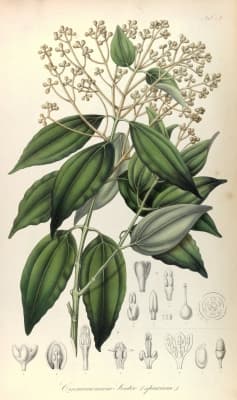
Cinnamomum sintoc
Cinnamomum sintoc
Safety & Hazards
None known
Cultivation Details
Species in this genus generally prefer an acidic soil with ample moisture in the growing season and a position with some shade[1]. Species in this genus are generally able to resprout from basal wood if the top is damaged, and will soon recover from any damage[1].
Propagation
Seed - the seed of species in this genus generally has a short viability and is best sown as soon in containers as it is ripe[2]. Remove the fruit pulp since this can inhibit germination[2]. Soaking the seeds for 24 hours in lukewarm water hastens germination[3], which can take 1 - 6 months at 20°c[4]. The germination rate of fresh seed is about 50%, falling to 25% for seed 6 months old, and zero for those 1 year old[3]. Stored seed should be sown as soon as possible in containers[5]. When they are large enough to handle, prick the seedlings out into individual pots and plant them out into their permanent positions when 10cm or more tall. Cuttings of semi-ripe side shoots, 7cm with a heel, in a frame with bottom heat[5]. Cite as: Tropical Plants Database, Ken Fern. tropical.theferns.info. 2026-02-20. <tropical.theferns.info/viewtropical.php?id=Cinnamomum+sintoc>
Pollinators
Data unavailable
References
- [1]New Trees — Grimshaw J.; Bayton R.; Wilks H. · Kew Publishing; London · 2009 · ISBN 1842461737 ↩︎Provides comprehensive botanical descriptions and horticultural commentary on over 800 tree species that have been introduced to cultivation in recent decades.
- [2]The New RHS Dictionary of Gardening. 1992. — Huxley. A. · MacMillan Press · 1992 · ISBN 0-333-47494-5 ↩︎Excellent and very comprehensive, though it contains a number of silly mistakes. Readable yet also very detailed.
- [3]World Agroforesty Centre — http://www.worldagroforestry.org/ ↩︎An excellent online database of a huge range of trees giving very good information on each plant - its uses, ecology, identity, propagation, pests etc.
- [4]Growing from Seed. Volume 4. — Bird. R. (Editor) · Thompson and Morgan. · 1990 · ISBN - ↩︎Very readable magazine with lots of information on propagation. A good article on Yuccas, one on Sagebrush (Artemesia spp) and another on Chaerophyllum bulbosum.
- [5]Propagation of Trees, Shrubs and Conifers. — Sheat. W. G. · MacMillan and Co · 1948 · ISBN - ↩︎A bit dated but a good book on propagation techniques with specific details for a wide range of plants.
- [6]Flora of Peninsula Malaysia — http://www.tfbc.frim.gov.my ↩︎In the process of being assembled (15/07/09), it is currently a series of check sheets giving species name, brief description, habitat and high quality photos of the plants.
- [7]Trees of Laos and Vietnam - A Field Guide to 100 species. — Hoang Van Sam; Khamseng Nanthavong; Kessler P.J.A. · Blumea · 2004 ↩︎A detailed guide, with excellent line-drawings, to 100 of the more important trees of Laos and Vietnam. A very good work, giving lots of information about each plant. Originally published in the journal Blumea, it is available as a PDF on the Interne
- [8]Dictionary of Economic Plants. — Uphof. J. C. Th. · Weinheim · 1959 · ISBN - ↩︎An excellent and very comprehensive guide but it only gives very short descriptions of the uses without any details of how to utilize the plants. Not for the casual reader.
- [9]Taxonomic revision of Cinnamomum (Lauraceae) in Borneo — Soh Wuu-Kuang · 2011 · http://dx.doi.org/10.3767/000651911X615168 ↩︎
- [10]Plants of Southeast Asia — http://www.asianplant.net/ ↩︎Excellent site with brief information on the plant, its range, habitat and uses, plus phots of specimens, close-ops of flowers and leaves etc,
- [11]Timber Notes - Light Hardwoods II — Gan K.S.; Lim S.C.; Choo K.T. · Forest Research Institute; Malaysia · 1998 · ISBN 139-258 ↩︎Part of an excellent series of publications, this one giving a brief guide to five lesser known groups of light hardwoods from southeast Asia. It is available in PDF format on the Internet.
- [12]Five hundred plant species in Gunung Halimun Salak National Park, West Java — Hari Priyadi et al · Center for International Forestry Research; Indonesia. · 2010 · http://www.cifor.cgiar.org · ISBN 978-602-8693-22-6 ↩︎Brief details of the uses of 500 Indonesian plants. It is available as a PDF document to download from the internet.