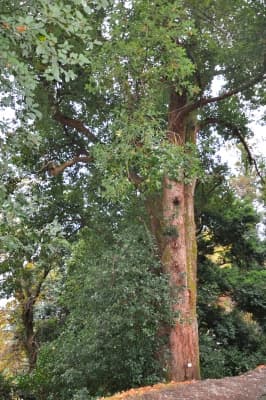
Cinnamomum glanduliferum
Cinnamomum glanduliferum
Safety & Hazards
None known
Cultivation Details
Cinnamomum glanduliferum is a plant of warm temperate to tropcal climates in China, India and southeast Asia. It is able to tolerate short-lived frosts, probably down to -5°c, possibly lower. It needs to grow in areas with ample summer heat in order to ensure that it thoroughly ripens the current season's growth, otherwise it will be less winter-hardy[1]. Requires a very sunny position in climates with cooler summers, but otherwise requires some shade from the strongest sun. Prefers an acidic soil with ample moisture in summer[1]. Species in this genus are generally able to resprout from basal wood if the top is harmed, and will soon recover from frost damage[1]. Almost all parts of the plant are aromatic.
Propagation
Seed - the seed has a short viability and is best sown as soon as it is ripe in a greenhouse[2]. Remove the fruit pulp since this can inhibit germination[2]. Germination can take 1 - 6 months at 20°c[3]. Stored seed should be sown as soon as possible in a warm greenhouse[4]. When they are large enough to handle, prick the seedlings out into individual pots and grow them on in a greenhouse for at least their first winter. Plant them out into their permanent positions in late spring or early summer, after the last expected frosts. Consider giving them some protection from the cold for at least their first two winters outdoors. Cuttings of semi-ripe side shoots, 7cm with a heel, early summer/July in a frame with bottom heat[4]. Cite as: Temperate Plants Database, Ken Fern. temperate.theferns.info. 2026-02-20. <temperate.theferns.info/plant/Cinnamomum+glanduliferum>
Pollinators
Data unavailable
References
- [1]New Trees — Grimshaw J.; Bayton R.; Wilks H. · Kew Publishing; London · 2009 · ISBN 1842461737 ↩︎Provides comprehensive botanical descriptions and horticultural commentary on over 800 tree species that have been introduced to cultivation in recent decades.
- [2]The New RHS Dictionary of Gardening. 1992. — Huxley. A. · MacMillan Press · 1992 · ISBN 0-333-47494-5 ↩︎Excellent and very comprehensive, though it contains a number of silly mistakes. Readable yet also very detailed.
- [3]Growing from Seed. Volume 4. — Bird. R. (Editor) · Thompson and Morgan. · 1990 · ISBN - ↩︎Very readable magazine with lots of information on propagation. A good article on Yuccas, one on Sagebrush (Artemesia spp) and another on Chaerophyllum bulbosum.
- [4]Propagation of Trees, Shrubs and Conifers. — Sheat. W. G. · MacMillan and Co · 1948 · ISBN - ↩︎A bit dated but a good book on propagation techniques with specific details for a wide range of plants.
- [5]Flora of China — Missouri Botanical Garden Press; St. Louis. · 1994 · http://flora.huh.harvard.edu/china/ ↩︎An excellent, comprehensive resource in 25 volumes. In addition to the botanical information the flora also gives basic information on habitat and some uses. An on-line version is also available.
- [6]Exploration of antimicrobial potential of essential oils of Cinnamomum glanduliferum, Feronia elephantum, Bupleurum — Charu Singh; Shalini Singh; Chitra Pande; Geeta Tewari; Veen · 2013 · http://doi.org/10.3109/13880209.2013.805234 · ISBN 1744-5116 ↩︎